Discover New Doors: Bifold, Frames, and More
A guide to door styles, hinged, bifold, pocket, barn, French, and sliding glass doors, plus how door frames and slab vs pre-hung sizing work.
Discover Door Styles: Bifold, Frames, and More
Doors do far more than close off rooms; they shape how a home flows, how much light travels between spaces, and how a room feels. Yet most people never think past the standard hinged door until a renovation forces the question. Discovering the range of door styles available, and understanding the frame that holds them, opens up practical solutions for tight spaces, better light, and a more polished look throughout the house. This guide covers the main door styles, the frames behind them, materials, and how to choose the right door for each opening.
Hinged (Swinging) Doors
The most familiar option is the hinged, or swinging, door, mounted on hinges to open into or out of a room. It is the default for good reason, simple, reliable, and available in endless styles, but it does require clear floor space for the arc of its swing.
- Panel doors, with recessed or raised rectangular sections, are the classic interior choice.
- Flush doors present a flat, minimalist face.
When a hinged door works for the space, the main decisions are material, panel style, and finish. You will also choose a swing direction (left or right hand) and whether it opens into or out of the room.
Space-Saving Doors: Bifold, Pocket, and Barn
Where floor space is tight, space-saving doors shine:
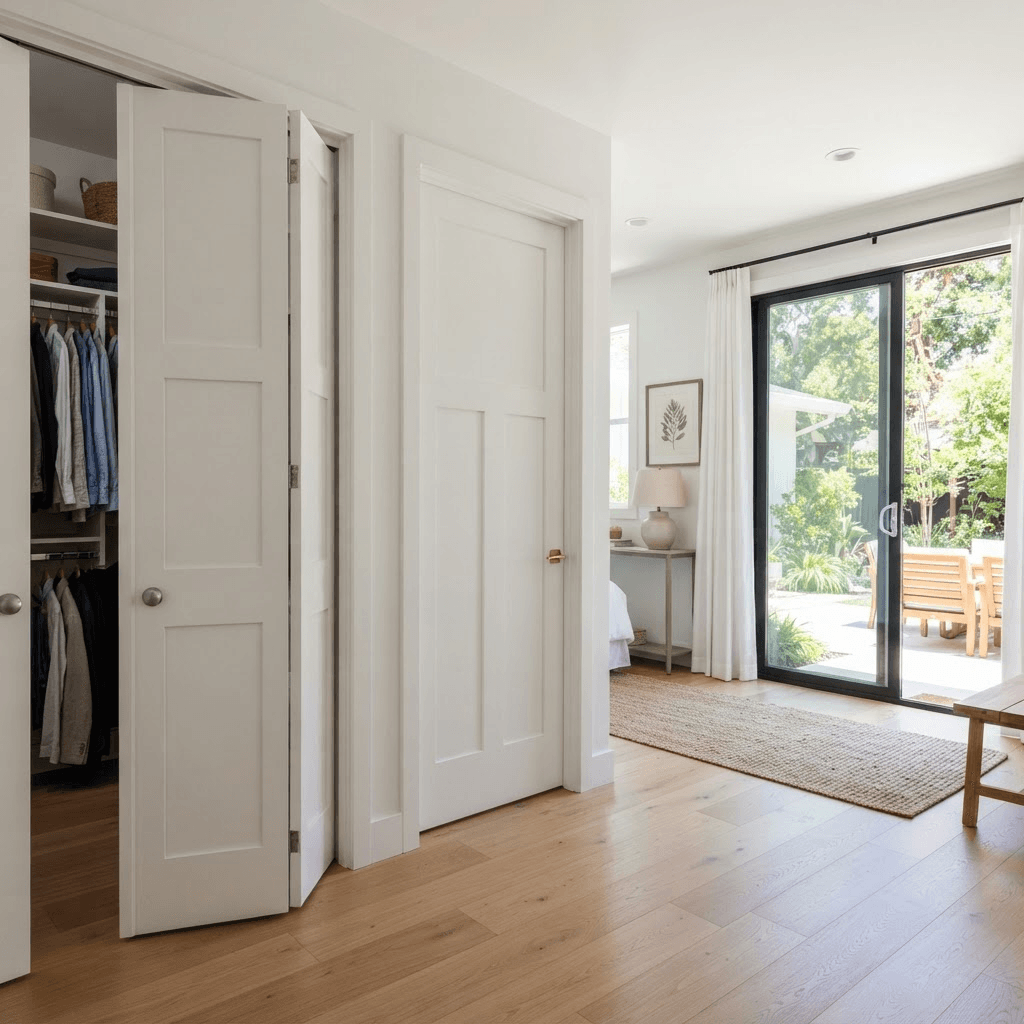
- Bifold doors fold in on themselves along a track, splitting into two or more hinged panels that stack neatly to the side, which makes them a popular choice for closets, pantries, and laundry areas where a full swing would be awkward. They give you wide access to an opening without needing clearance for a swinging slab.
- Pocket doors go a step further, sliding completely into a hollow inside the wall so they disappear when open, ideal for bathrooms, small rooms, and anywhere you want the option of an opening with zero footprint.
- Barn doors slide along an exposed track mounted on the wall, offering the same space savings with a decorative, statement-making look that has become extremely popular in modern and farmhouse interiors.
Each of these solves the same core problem, a swinging door that wastes floor space, in a different way.
Glass Doors: French and Sliding Patio Doors
For connecting rooms or bringing in light and views, glass-forward doors are the go-to:
- [French doors](/blog/french-door-width-guide-interior-french-doors) are a pair of hinged doors, usually with glass panels, that open from the center to create a wide, elegant opening between rooms or out to a patio.
- Sliding patio doors glide on a track and are perfect for exterior walls where a swinging door would intrude, delivering big glass area, natural light, and easy access to outdoor spaces.
Glass doors are the best way to keep sightlines open and rooms bright while still allowing separation when needed.
Understanding Door Frames
Behind every door is the frame, and it matters more than most homeowners realize. The frame (or jamb) holds the door square, carries its weight, and provides the surface the door seals against. A poorly installed or out-of-square frame causes sticking, drafts, and gaps no matter how good the door is.
- Prehung doors come already mounted in a complete frame, making installation faster and squareness easier to achieve, which is why they are popular for renovations and new construction.
- Slab doors are just the door itself, meant to hang in an existing frame, a good choice when the frame is sound and you are simply replacing the door.
For exterior doors, the frame also anchors the weatherstripping and threshold that keep out air and water, so frame quality directly affects energy efficiency.
Door Materials and What They Mean
Doors are made from several materials, each with trade-offs:
- Solid wood is classic, heavy, and beautiful, but can swell or warp with moisture.
- Hollow-core doors are lightweight and affordable, common for interiors, but offer little sound insulation.
- Solid-core doors have a dense filler that mimics solid wood's feel and soundproofing at lower cost.
- Fiberglass and steel are durable, energy-efficient exterior choices that resist warping and weather.
Match the material to the door's job: sound and durability for interiors, security and insulation for exteriors.
How to Choose the Right Door
Start with the opening and how the space is used. Ask whether you need to save floor space (bifold, pocket, or barn), maximize light (French or sliding glass), or simply replace a standard interior door (panel or flush). Consider privacy, sound, and whether the door is interior or exterior. Then confirm the frame situation, prehung for new or problem openings, slab for sound existing frames, and pick a material suited to the location. Accurate measurements of the rough opening are essential to avoid ordering the wrong size.
Final Thoughts
Doors are one of the most underrated tools in home design. Once you look past the standard hinged slab, options like bifold, pocket, barn, French, and sliding doors solve real problems, tight spaces, poor light flow, awkward layouts, while adding style. Pair the right door with a solid, square frame and a material suited to the job, and every opening in your home will work better and look more finished.
If one of these styles solves a problem in your layout, our door design inspiration goes further on sizing and installation.