How do Solar Cells Create Electricity? (How Solar Energy is Formed)
Learn exactly how solar cells create electricity, from photons striking silicon to the photovoltaic effect that powers your home.
How Do Solar Cells Create Electricity? (How Solar Energy Is Formed)
It seems almost too simple: point a flat panel at the sky and electricity comes out. But inside every solar cell, a genuinely remarkable process is unfolding, one rooted in the physics of light and matter.
Understanding how a solar cell actually creates electricity turns the panels on a roof from a black box into something you can picture working, particle by particle.
It Starts With Light: What Is a Photon?
Sunlight is made of tiny packets of energy called photons, streaming from the sun in astonishing numbers. Each photon carries a small amount of energy, and it's this energy — not heat — that solar cells are designed to capture.
That distinction matters: a solar cell doesn't burn or warm anything. It harvests the energy carried by individual particles of light.
Silicon: The Material That Catches Sunlight
The material that catches those photons is [silicon, a semiconductor](/blog/what-are-solar-panels-made-of-monocrystalline-explained). In its pure form, silicon isn't especially useful for making electricity, so manufacturers deliberately add tiny amounts of other elements in a process called doping.
Doping creates two slightly different layers:
- An n-type layer with a surplus of loose electrons
- A p-type layer with a shortage of electrons — effectively spaces waiting to be filled
The Junction: Where the Magic Starts
Where these two layers meet, something crucial happens. The mismatch in electrons creates a built-in electric field at the junction between them, a kind of invisible one-way slope.
This field is the heart of the cell. It doesn't produce electricity on its own, but it's the mechanism that will later force freed electrons to move in a single, useful direction rather than wandering randomly.
The Photovoltaic Effect: How Sunlight Frees Electrons
Now the sunlight goes to work. When a photon with enough energy strikes the silicon, it transfers that energy to an electron and knocks it loose from its atom. This is the essence of the photovoltaic effect: light energy becoming freed electrons.
Each dislodged electron leaves behind a hole, the empty space where it used to be, and suddenly there are mobile charges available to do something.
How the Electric Field Creates Voltage
Left alone, those freed electrons would simply drift and recombine. But the built-in electric field at the junction sweeps them consistently toward one side of the cell, while the holes are pushed the other way.
This organized separation of charge is what creates voltage, an electrical pressure, across the cell. It's the difference between a room full of people milling about and a crowd all moving through one door.
Turning Voltage Into Usable Electric Current
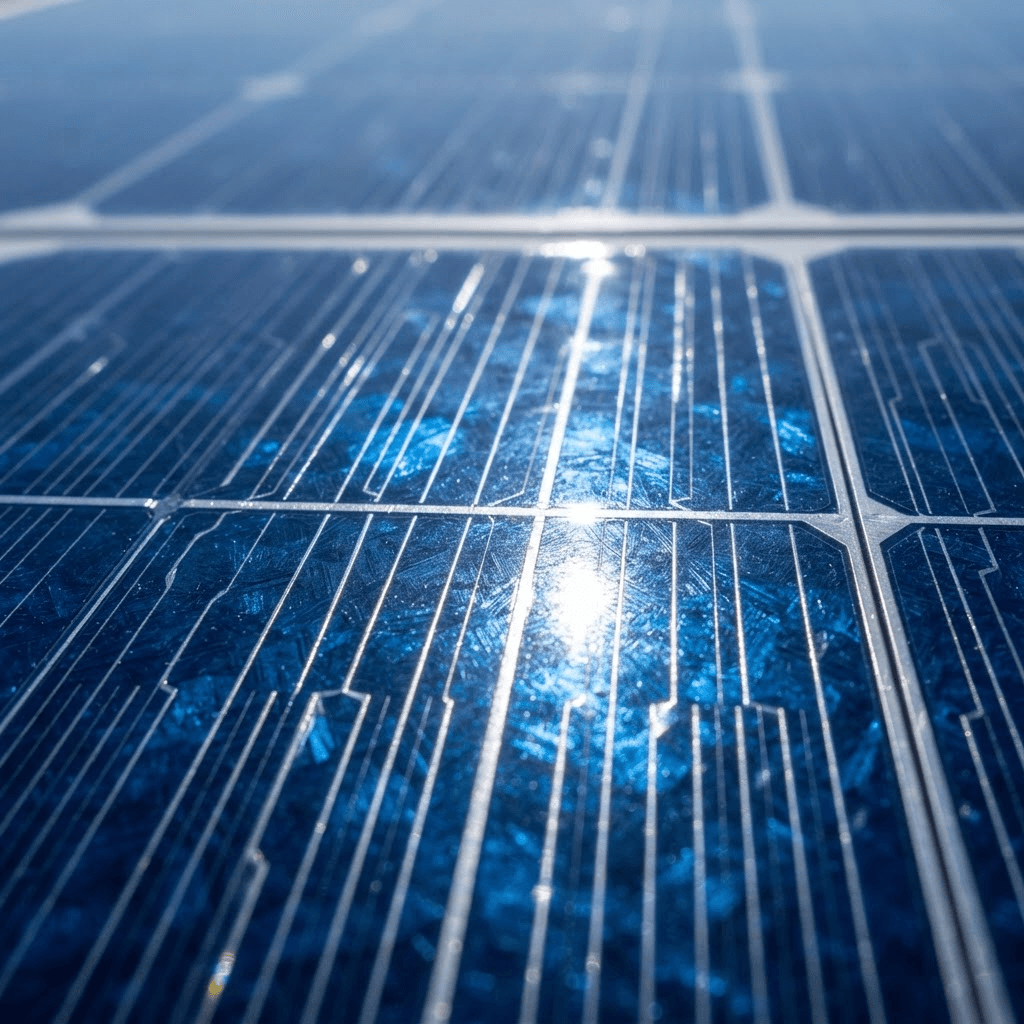
To turn that pressure into usable current, the cell needs a path. Thin metal contacts printed on the surface and back of the cell collect the gathered electrons and provide a route out through an external circuit — your wiring, your home, the grid.
As electrons flow through that circuit to reach the holes on the other side, that flow is electric current, and current through your devices is electricity doing work.
From DC to AC: How Solar Power Reaches Your Home
At this stage, the cell produces direct current (DC), a steady one-way flow. Because homes and the grid run on alternating current (AC), an inverter converts the cell's DC into AC.
So the full chain of solar energy formation is:
- Photons strike silicon
- Electrons break free
- The electric field herds them into a current
- Metal contacts route that current out
- An inverter shapes it into household power
From a Single Cell to a Full Solar Panel
A single cell only produces a small voltage, so cells are wired together to build something practical. Dozens of cells are connected and sealed into a panel, and multiple panels are combined into an array.
Each cell contributes its modest flow, and together they add up to enough electricity to run a house — all from the same tiny photon-and-electron interaction repeated trillions of times a second.
From this single cell up to a working rooftop array, our articles on how solar works trace each step in between.
Frequently Asked Questions
How do solar cells create electricity, in simple terms? Sunlight particles called photons strike silicon in the cell, knocking electrons loose. A built-in electric field in the silicon then pushes those electrons in one direction, creating a flow of electricity called current.
Do solar cells need heat to work? No. Solar cells convert light energy directly into electricity through the photovoltaic effect. They don't rely on heat, and in fact, panels can lose some efficiency when they get too hot.
Why do solar panels produce DC instead of AC power? The photovoltaic effect naturally produces a one-way flow of electrons, known as direct current (DC). An inverter is required to convert that DC into the alternating current (AC) that homes and the grid use.
Why are solar cells wired together into panels? A single solar cell only produces a small voltage, not enough to power much on its own. Wiring dozens of cells together into a panel, and multiple panels into an array, combines their output into a usable amount of electricity.
The Bottom Line
What's striking is that this all happens silently, with no moving parts and no fuel, just light meeting a cleverly arranged piece of silicon. Solar energy isn't so much generated as it is redirected: the sun's energy, already pouring down for free, is caught and channeled into a form we can use.
Once you can picture photons freeing electrons and a hidden field steering them home, the quiet panel on the roof becomes one of the most elegant machines ever built.
From Freed Electrons to Usable Power
Once photons knock electrons loose and the junction's electric field pushes them in one direction, that organized flow of electrons is electric current. Metal contacts printed on the front and back of the cell collect this current and route it into wires. Connect many cells together in a panel, and their combined output becomes enough to do real work. This is the photovoltaic effect turned into practical electricity, silent and continuous whenever light strikes the cell.
Why Cells Are Wired Together Into Panels
A single silicon cell produces only about half a volt, far too little to be useful on its own. Manufacturers wire dozens of cells in series inside a panel to build up a usable voltage, then combine panels into arrays to reach the power a home needs. This is why your roof holds many panels rather than one giant cell: stacking many small voltages is how solar reaches practical levels.
DC to AC: The Inverter's Job
The electricity a solar cell produces is direct current (DC), flowing steadily in one direction. Homes and the grid, however, run on alternating current (AC). The inverter bridges this gap, rapidly switching the DC into grid-compatible AC many times per second. Without the inverter, the raw output of your cells could not power household appliances or feed the utility grid, making it one of the most important components in the whole system.
What Limits a Cell's Efficiency
No cell converts all the sunlight it receives into electricity. Some photons carry too little energy to free an electron, some carry more than needed and waste the excess as heat, and some light reflects away. These physical limits are why typical silicon cells convert around 20 percent of sunlight into electricity. Anti-reflective coatings, purer silicon, and advanced cell designs push that figure higher, which is the frontier of ongoing solar research.
Frequently Asked Questions
How does a solar cell make electricity? Photons from sunlight knock electrons loose in silicon, and the cell's built-in electric field forces those electrons to flow in one direction, creating an electric current that metal contacts collect.
Do solar cells produce AC or DC electricity? They produce direct current (DC). An inverter converts it into the alternating current (AC) that homes and the grid use.
Why is silicon used in solar cells? Silicon is an abundant semiconductor that can be doped to create the two layers and the junction needed for the photovoltaic effect, making it ideal and cost-effective for solar cells.
Why are solar cells only about 20 percent efficient? Physical limits mean some light lacks the energy to free electrons, some wastes excess energy as heat, and some reflects away, capping the share of sunlight a typical cell can convert.