How to Get Jobs in Solar (PV Installation and Sales)
Solar hires more entry-level workers than almost any other trade. A guide to the installation and sales tracks, what each pays, and how to land your first role.
How to Get Jobs in Solar (PV Installation and Sales)
Solar is one of the few industries where you can walk in with no experience and be on a roof, earning a paycheck, within a few weeks. Crews are always short-handed, the training happens on the job, and the work itself is learnable by anyone willing to show up early and pay attention. If you are still deciding whether the industry interests you, it helps to first understand how solar panels actually turn sunlight into electricity — the job makes a lot more sense once the technology does.
There are really two doors into solar, and they attract very different people. One is the field side: installation, racking, wiring, service. The other is the customer side: sales, lead generation, and design consulting. Both can pay well. Neither requires a four-year degree.
Why solar keeps hiring
Every installed system is a small construction project with a permit, a design, a crew, and an inspection. That work cannot be outsourced or automated away, because someone has to physically be on the roof. As more homeowners run the numbers on the cost of solar versus the cost of grid electricity, the volume of those small projects keeps climbing — and each one needs hands.
The practical result for a job seeker is that solar companies hire on attitude and reliability far more than on résumé. Showing up on time, every time, genuinely makes you a strong candidate.
Track one: PV installation
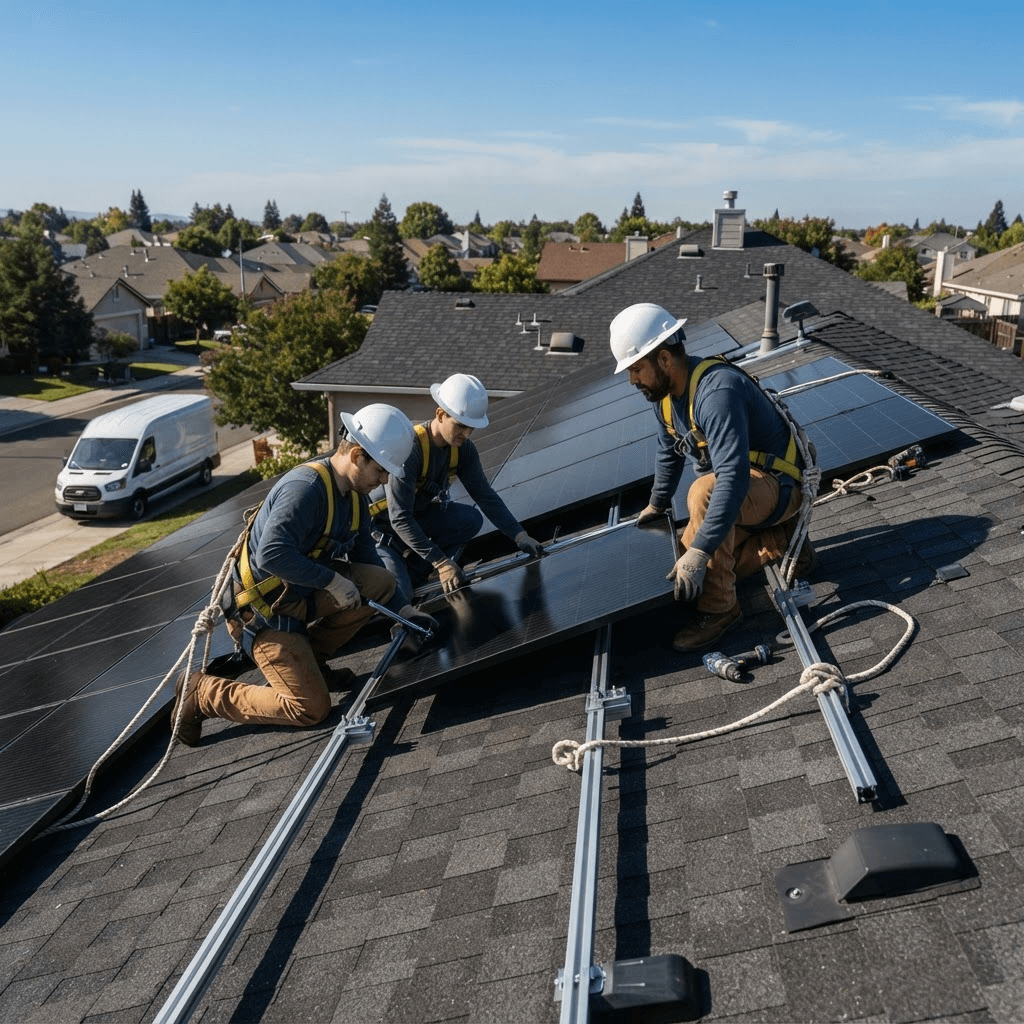
Installation is the backbone of the industry. A residential crew is usually three to five people, and the roles stack in a clear ladder:
- Installer helper or apprentice: you carry panels, stage materials, hand tools up, and learn the sequence. This is the true entry point and needs no prior experience.
- Installer: you set racking and rails, flash penetrations so the roof stays watertight, and mount modules to spec.
- Lead installer or foreman: you run the crew, own the layout, and answer to the inspector.
- Electrician or PV electrical lead: you handle conduit, inverters, combiner boxes, and the service panel interconnection. This is the licensed, highest-paid field role.
Not every solar job is on a roof. A solar permit coordinator assembles permit packages and files utility interconnection applications from a desk, and the role is often fully remote — worth knowing if the physical side of the work is a barrier for you.
The single most useful thing to understand early is wiring topology — why modules get grouped the way they do, and what happens to voltage and current in each arrangement. Reading up on series versus parallel solar wiring before an interview will put you ahead of most applicants.
What the day actually looks like
Early start, usually 6 or 7 a.m., because afternoon roof surfaces get brutally hot. You will be on a ladder, in an attic, or on a pitched roof for most of the day, carrying modules that are awkward more than heavy. Expect sun exposure, harnesses, and a lot of repetitive lifting.
It is physical work with real fall risk, which is exactly why safety training is not a formality. Crews that cut corners on tie-offs are crews to leave.
Track two: solar sales
Sales is the other half of the industry, and the ceiling is higher. Most residential solar sales roles are commission-heavy, meaning your income tracks your output far more directly than in the field.
- Lead generator or canvasser: you set appointments, often door to door. Lowest barrier to entry of any solar job. If this is the route you are considering, our guide to generating leads in solar and landscaping covers the mechanics.
- Solar consultant or closer: you sit with homeowners, model their usage, and present a proposal.
- Sales manager: you recruit, train, and take a share of team production.
The skill that separates good solar salespeople from bad ones is not charisma — it is numbers. You have to explain a 25-year financial decision honestly, which means genuinely understanding cash, loans, leases, and PPAs and being able to say plainly when solar is a poor fit for a particular roof. The people who last in this job are the ones homeowners trust.
What you can earn
Compensation varies widely by state, company, and how utility rates are structured locally, so treat any single number with suspicion. The general shape, though, is consistent:
- Entry-level installer helpers typically start near the local construction-labor wage.
- Experienced installers and leads earn meaningfully more, with overtime common in peak season.
- Licensed electricians on the PV side sit at the top of the field pay scale.
- Commission sales has the widest spread of all: weak months can be genuinely thin, strong months can outpace every field role on this list.
Certifications worth having
None of these are strictly required to get hired, but each one makes you cheaper to insure and easier to promote:
- OSHA 10 or OSHA 30 — construction safety. Fast, inexpensive, and the most immediately useful credential you can hold.
- NABCEP Associate — the recognized entry-level PV knowledge credential in North America.
- Fall protection and ladder safety — often provided in-house during your first week.
- Electrical apprenticeship hours — if you want the licensed track, start logging these early. Our guide on becoming an electrical apprentice covers how that pipeline works.
How to land the first job
Apply directly to regional installers rather than only to the national brands — smaller shops hire faster and teach more. Then:
- Say plainly that you are comfortable working at height, if you are. It is the first thing they screen for.
- Get OSHA 10 before you apply. It costs little and signals that you are serious.
- Mention any roofing, framing, or general labor experience. Roof familiarity transfers directly.
- Ask about the training path in the interview. Companies that cannot describe one are companies that will leave you carrying panels for three years.
Is solar right for you?
Take the field track if you would rather be outside and moving, and you want a skill that stays in demand. Take sales if you are comfortable with variable income and can hold a conversation about money without flinching. Either way, solar remains one of the shortest paths from no experience to a genuine trade — and the systems you install will still be producing power decades from now.