Top 3 Window Types: Casement, Awning, and Picture Windows
Casement, awning, and picture windows compared, how each operates, their pros and trade-offs, and how to choose the right one for each room.
Top 3 Window Types: Casement, Awning, and Picture Windows
Choosing new windows means wading through a surprising number of styles, but three stand out for their looks, efficiency, and versatility: casement, awning, and picture windows. Each opens, or doesn't, in its own way, and each shines in particular spots around the house. Understanding how they differ makes it much easier to pick the right window for each room rather than defaulting to whatever is most familiar. For homeowners planning a renovation or a new build, windows are a long-term investment that affects comfort, energy bills, natural light, curb appeal, and even resale value, so it pays to understand your options before you buy.
This guide breaks down the three most popular window types, explains where each one performs best, and walks through the practical factors, energy efficiency, materials, cost, and installation, that determine whether you are making a smart choice for your home.
What Determines the Right Window for a Room
Before comparing individual styles, it helps to know what actually matters when selecting a window. The best choice depends on how a room is used and what you want the window to do. Ask yourself a few questions: Do you need ventilation, or just light and a view? Is the window over an obstacle like a sink, patio, or walkway? How much privacy does the room require? What direction does the wall face, and how much sun does it get? Answering these first narrows the field quickly, because each window style has a job it does better than the others.
Two windows can look nearly identical from the street yet perform very differently in terms of airflow, sealing, and ease of use. That is why matching the window type to the room, rather than buying one style for the whole house, produces a more comfortable and efficient home.
Casement Windows
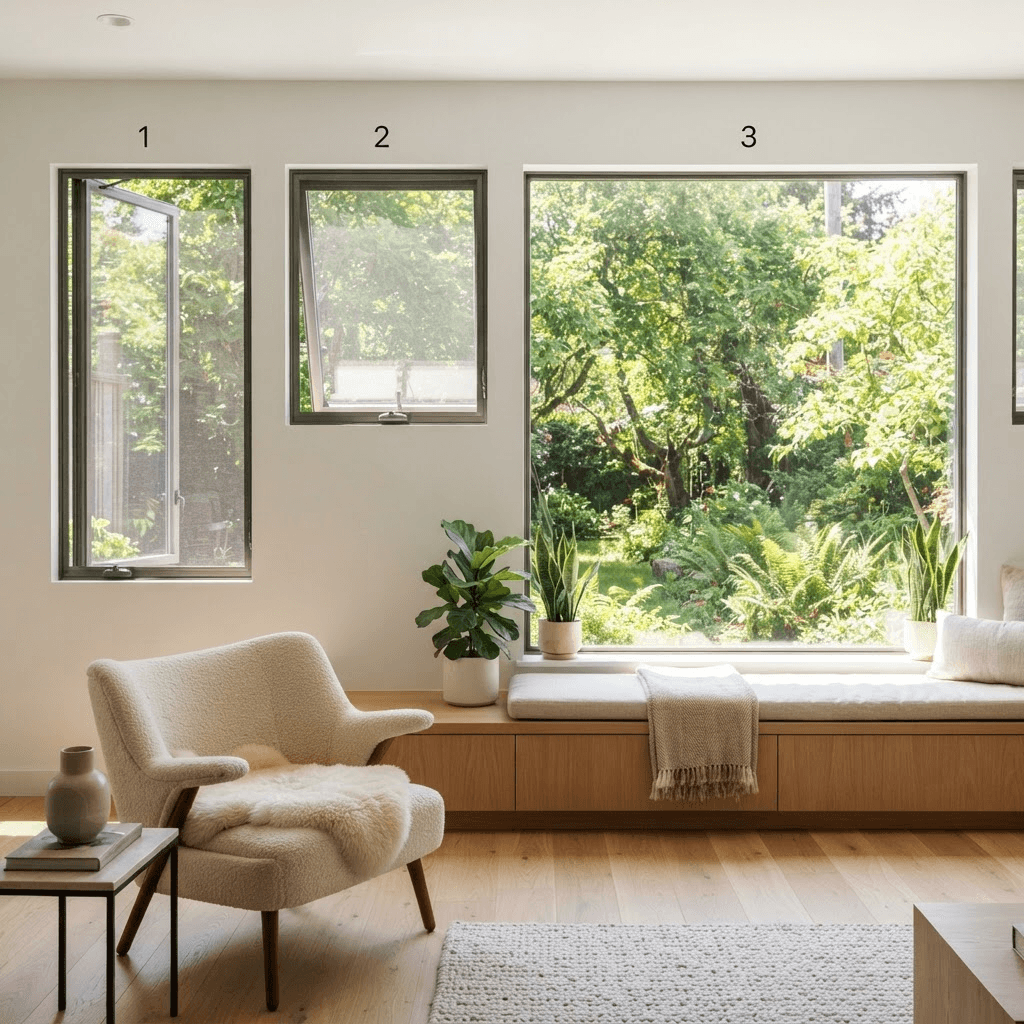
Casement windows are hinged on the side and swing outward like a door, operated by turning a crank. Their biggest advantage is ventilation: because the entire sash opens, they catch and funnel breezes into the room far better than a window that only slides halfway. When you angle the open sash toward a prevailing breeze, it acts almost like a scoop, directing fresh air into the living space.
They also seal tightly, since the sash presses against the frame when closed, which makes casements one of the most energy-efficient operating windows you can buy. As the window closes, the sash is drawn firmly against a continuous weatherstrip, creating an airtight seal that resists drafts and air leakage. This tight seal is a major reason casements consistently earn strong energy-efficiency ratings and help lower heating and cooling costs.
Casements are a favorite over kitchen sinks and in hard-to-reach spots where a crank is easier than lifting a heavy sash. They also provide an unobstructed view because there is no rail dividing the glass, and they are easy to clean since many models let you reach the exterior glass from inside.
The main trade-offs are that they project outward when open, so they are not ideal over walkways, patios, or decks where someone could walk into them, and their mechanical cranks and hinges can eventually wear and need maintenance or replacement. They are also typically limited in maximum width because the hardware must support the weight of the swinging sash.
Awning Windows
Awning windows are hinged at the top and swing outward from the bottom, again operated by a crank. That top hinge is their signature strength: because the open sash forms a small awning over the opening, you can leave them open during light rain without water getting in. This makes them uniquely useful for keeping fresh air moving through a home even in wet weather.
They are excellent for ventilation in bathrooms, basements, and other spots where you want fresh air and privacy, and they are often placed higher on a wall or paired above or below fixed windows. Because they sit high, they let in light and air while preserving privacy and wall space for furniture below. Like casements, they seal tightly against the frame for strong energy efficiency and low air leakage.
Awning windows also combine beautifully with picture windows in a single composition, a large fixed pane flanked or topped by operable awnings gives you an expansive view plus controllable ventilation. Their limitations are the modest sizes they are usually made in, the outward projection when open, and the fact that the screen sits on the interior side, which some homeowners find slightly less convenient to clean.
Picture Windows
Picture windows are large, fixed panes of glass that do not open. What they give up in ventilation they more than repay in three areas: view, natural light, and energy efficiency. Because there are no moving parts, seams, or operating hardware, a picture window can be sealed completely airtight, making it the most energy-efficient window style available and eliminating the drafts that come from worn weatherstripping.
They flood a room with daylight and frame outdoor views like artwork, which is exactly where the name comes from. They work best in living rooms, stairwells, and great rooms with a view worth showing off, and on walls where you do not need airflow. Because they can be manufactured in large sizes, they make dramatic architectural statements and can transform how open and bright a space feels.
The obvious limitation is that they provide no ventilation, so they should not be the only window in a room that needs fresh air. The common solution is to combine a central picture window with operable casement or awning windows on either side, capturing the light and view of the fixed pane while keeping the airflow of the operable ones.
Comparing Energy Efficiency
Energy efficiency is where these three window types genuinely shine, and it is measured by a few key ratings you will see on window labels. The U-factor measures how well a window insulates, lower numbers mean better insulation and less heat loss. The Solar Heat Gain Coefficient (SHGC) measures how much solar heat passes through the glass, which matters more in hot climates. Air leakage rates tell you how drafty a window is.
Because casement and awning windows clamp tightly shut and picture windows do not open at all, all three outperform sliding and single-hung windows on air leakage. Pairing any of them with double- or triple-pane glass, low-emissivity (low-E) coatings, and inert gas fills like argon between the panes pushes efficiency even higher, lowering your energy bills and improving comfort year-round.
Window Materials and What They Mean for You
The frame material affects durability, maintenance, appearance, and price. The most common options include:
- Vinyl, the most affordable and low-maintenance choice, resists moisture and never needs painting, though color options are more limited.
- Fiberglass, stronger and more dimensionally stable than vinyl, handles temperature swings well and holds paint, making it a premium long-lasting option.
- Wood, prized for its classic look and natural insulation, requires the most upkeep to protect against rot and moisture.
- Aluminum, strong and slim-profiled, is durable but conducts heat readily, so it is less energy efficient unless it has a thermal break.
For most homeowners, vinyl and fiberglass offer the best balance of efficiency, durability, and value for casement, awning, and picture windows.
Cost Considerations
Window prices vary widely based on size, material, glass package, and installation. As a general guide, picture windows are often the least expensive per square foot because they have no operating hardware, while casement and awning windows cost a bit more due to their cranks, hinges, and seals. Larger custom sizes, triple-pane glass, and premium materials raise the price. Remember that professional installation is a significant part of the total cost, and proper installation is essential, an efficient window installed poorly will still leak air and water.
How to Choose the Right Window for Each Room
The smartest approach is to mix window types based on each room's needs rather than choosing one style for the whole house. Use casement windows where you want maximum ventilation and an unobstructed view, such as kitchens and bedrooms. Use awning windows in bathrooms, basements, and rainy climates where you want airflow and privacy without letting water in. Use picture windows in living rooms and stairwells to capture light and views, and pair them with operable windows nearby for ventilation.
Final Thoughts
Casement, awning, and picture windows each solve a different problem, ventilation, weather-resistant airflow, and light-and-view, and the best home renovations use them together strategically. By matching the window type to how each room is used, and paying attention to energy ratings, frame materials, and quality installation, you get a home that is brighter, more comfortable, more efficient, and more valuable. When you understand what each style does best, choosing new windows becomes far less overwhelming and far more rewarding.
For the styles beyond these three and how they are priced, see our window type comparisons.