Low Voltage Outdoor Light Fixtures (Solar Exterior Lighting)
A guide to low voltage and solar outdoor lighting — how each system works, the fixture types available, and how to choose between them for a beautifully lit yard.
Low Voltage Outdoor Light Fixtures (Solar Exterior Lighting)
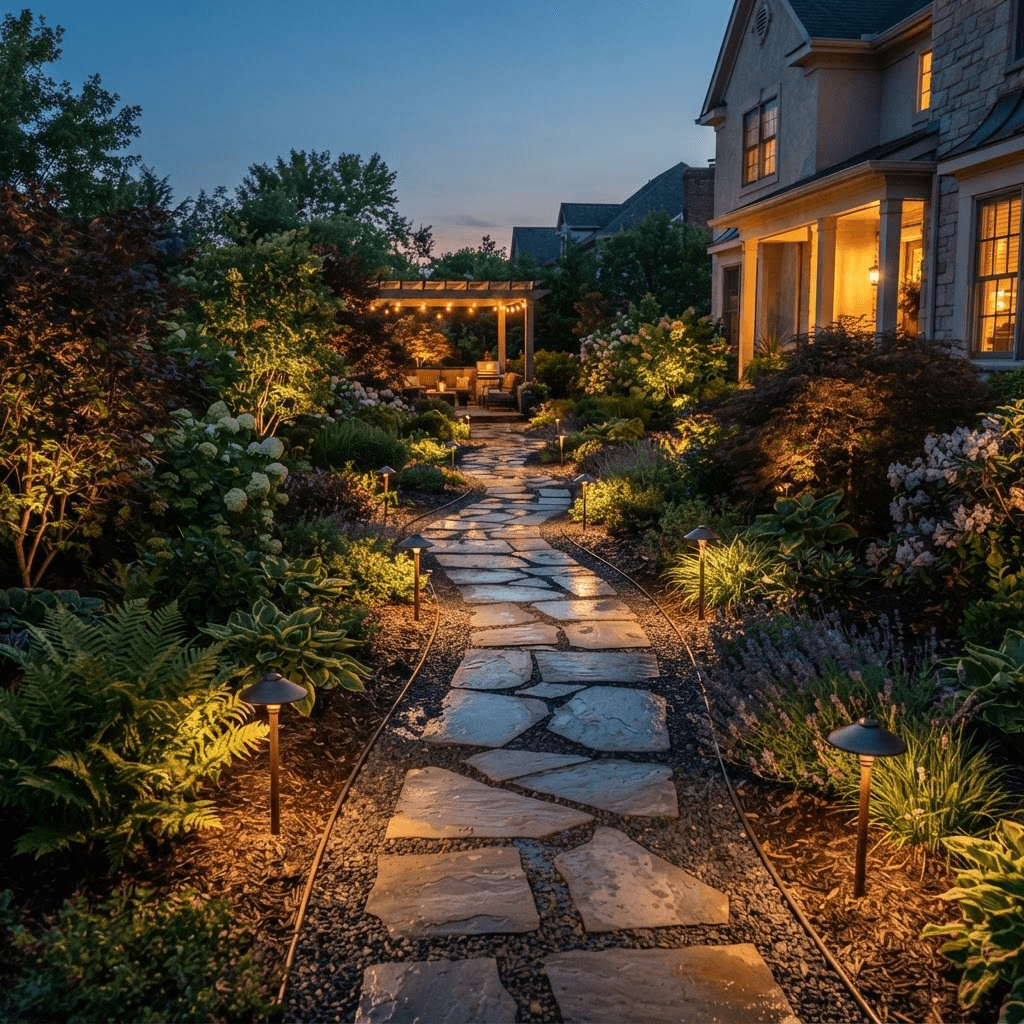
Outdoor lighting transforms a yard after dark, extending your living space into the evening while adding safety and curb appeal. But you don't need an electrician and a trench of high-voltage cable to get there. Low voltage and solar fixtures put professional-looking landscape lighting within reach of any homeowner, and understanding how each works makes it easy to light your yard beautifully and safely.
How Low Voltage Lighting Works
Low voltage lighting runs on 12 volts instead of the standard 120-volt household current, stepped down by a transformer that plugs into a regular outdoor outlet. That low voltage is the whole appeal: it's dramatically safer to work with, the cable can be buried shallowly or even laid in a mulch bed, and in most places you can install the entire system yourself without a permit or an electrician.
Despite the lower power, modern LED fixtures produce plenty of light, so you sacrifice nothing in effect.
How Solar Lighting Works
Solar lighting takes the simplicity even further by cutting the wiring entirely. Each fixture has a small photovoltaic panel that charges a built-in battery during the day and powers an LED at night, usually switching on automatically at dusk. There are no cables, no transformer, and no running costs, so installation is as easy as pushing a stake into the ground.
The trade-off is that solar fixtures depend on sunlight, so they're dimmer in shady spots and shorter-lived on cloudy stretches, and their output is generally softer than a wired system.
Fixture Types and Their Jobs
The fixture types are largely the same across both technologies, and each has a job:
- Path lights line walkways and borders, casting pools of light downward to guide safe movement.
- Spotlights and floodlights are directional fixtures aimed at a feature — uplighting a tree, washing a wall, or highlighting an architectural detail.
- Well lights sit flush in the ground for a hidden, dramatic uplight.
- Deck and step lights make stairs and seating areas safe.
- String and bistro lights add a warm, festive glow overhead.
Mixing a few types is what gives a yard depth rather than a flat, evenly-lit look.
Choosing Between Low Voltage and Solar
Choosing between low voltage and solar comes down to your priorities. Low voltage is the better choice when you want reliable, consistent brightness, control over the whole system with a single timer or smart transformer, and fixtures in shaded areas where solar would struggle; it costs more upfront and takes an afternoon to install.
Solar wins on pure convenience and zero operating cost, and it's ideal for sunny spots, quick additions, or areas far from any outlet. Many homeowners happily combine the two, wiring the main display and dotting solar lights where running cable isn't worth the effort.
Design Principles for a Look That Feels Intentional
A few design principles make any system look intentional rather than scattered. Aim for layers and highlights instead of blanketing the yard in light, since darkness and contrast are what make the lit features pop.
Choose warm-white LEDs (around 2700K to 3000K) for an inviting glow, and avoid glare by positioning fixtures so the bulb itself is hidden and only the effect is seen. Start with the key spots — the path to the door, a favorite tree, the entrance — and build out from there. With low voltage and solar fixtures doing the heavy lifting, a beautifully lit landscape is one of the easiest and most rewarding upgrades you can make.
Low-Voltage vs. Solar: The Core Difference
The two dominant options for outdoor lighting work in fundamentally different ways, and understanding that difference guides every other choice. Low-voltage systems run 12-volt power from a transformer through buried cable to each fixture, delivering consistent, controllable brightness every night regardless of weather. Solar fixtures, by contrast, harvest daylight through a small photovoltaic panel, store it in a rechargeable battery, and run entirely wire-free after dark. Low-voltage offers reliability and power; solar offers effortless, no-wiring installation. Matching that trade-off to your priorities is the first decision to make.
The Case for Solar Fixtures
Solar lighting has improved dramatically and now suits many outdoor situations beautifully. Its biggest advantage is installation: with no wiring, no transformer, and no trenching, you simply place fixtures where you want them and let the sun do the rest, making solar ideal for remote spots far from an outlet. There are no ongoing electricity costs, and modern LED-and-lithium units are brighter and longer-lasting than the dim solar lights of the past. The trade-offs are dependence on sunlight, so shaded spots and cloudy stretches dim performance, and batteries that need replacing every couple of years.
When Low-Voltage Wins
Despite solar's convenience, low-voltage lighting remains the choice for demanding applications. Because it draws steady power from the grid, it delivers reliable, uniform brightness all night, every night, unaffected by shade or overcast skies, which matters for security lighting, key architectural features, and large designed schemes. It also allows dimming, precise aiming, and heavier fixtures, and its buried cable and quality metal fixtures are built for decades of service. The trade-off is a more involved installation with a transformer, cable runs, and a nearby outlet, plus modest ongoing electricity use.
Choosing Fixtures for Function and Style
Whichever system you choose, selecting the right fixtures shapes both safety and ambiance. Path and bollard lights guide movement and mark edges, spotlights and well lights uplight trees and walls for drama, and wall or step lights improve safety on changes in level. Look for a warm color temperature around 2700K to 3000K for an inviting glow, a durable weatherproof housing in brass, copper, or coated aluminum, and an IP rating suited to outdoor exposure. Coordinating finishes and beam styles across the yard creates a cohesive, intentional look rather than a patchwork of mismatched lights.
Getting the Best Performance From Either System
A few habits maximize results no matter which type you install. For solar, place panels where they get maximum direct sun, keep the panels clean, and expect to swap batteries periodically to maintain brightness. For low-voltage, size the transformer to your total wattage with room to spare, use waterproof connectors, and add a photocell or timer for automatic dusk-to-dawn operation. In both cases, aim fixtures to hide the bulb and light the feature, and revisit positions as plants grow so the scheme keeps looking its best over the years.
Once you have settled on a system, our landscape lighting resources cover layout, fixture choice, and installation.
Frequently Asked Questions
Are solar or low-voltage lights better? It depends on priorities. Solar wins for easy, wire-free installation and zero electricity cost, while low-voltage wins for reliable, consistent brightness and demanding uses like security and architectural lighting.
Do solar landscape lights work in winter or shade? They work but with reduced performance, since they depend on daylight to charge. Shaded spots, short winter days, and long cloudy stretches all dim their output and shorten how long they stay lit at night.
Is low-voltage outdoor lighting safe to install myself? Generally yes. The 12-volt current is safe to handle, so most homeowners can install low-voltage systems, adding a transformer to a GFCI outlet. Only adding a new outlet typically calls for an electrician.
What color temperature is best for outdoor lighting? A warm range of about 2700K to 3000K gives a soft, inviting glow that flatters landscapes and architecture, while cooler temperatures can look harsh. Consistent color across fixtures keeps the scheme cohesive.