What Are Coach Lights? (Exterior Lamps and Lighting)
What coach lights are, how they fit into a full exterior lighting scheme, and practical tips on scale, placement, finish, and bulbs for choosing a pair.
What Are Coach Lights? (Exterior Lamps and Lighting)
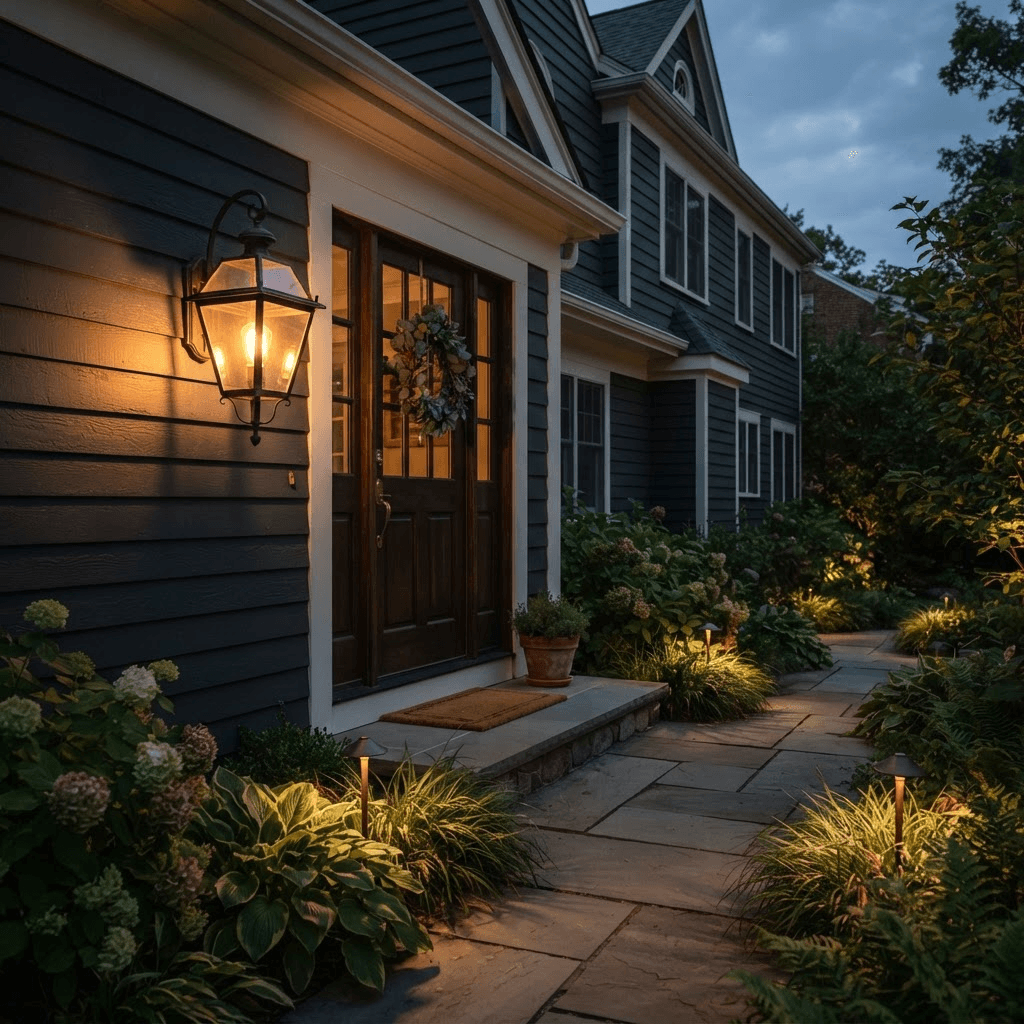
Coach lights are the lantern-style fixtures you've seen countless times without necessarily knowing their name — the paired lamps mounted on either side of a front door, along a garage, or beside an entry gate. The name comes from the oil lanterns that once hung on horse-drawn coaches, and the style has endured because it does two jobs at once: it lights the way and it dresses up the entrance. For anyone thinking about their home's curb appeal, coach lights are one of the highest-impact exterior fixtures you can install.
What Defines a Coach Light
What defines a coach light is its lantern shape: an enclosed housing, usually with glass panels, that holds the bulb and is mounted to the wall on a decorative bracket or arm. Traditional versions echo old gas lanterns with black or bronze metal frames and beveled or seeded glass, while modern takes go sleek with clean lines and simple geometry.
Because they're wall-mounted rather than freestanding, they frame doorways and architectural features beautifully, which is why they're almost always installed in symmetrical pairs.
Where Coach Lights Fit Within Exterior Lighting
It helps to see where coach lights fit within exterior lighting as a whole, which generally serves three overlapping purposes. There's ambient lighting for overall visibility, task lighting to illuminate specific spots like a doorway or steps, and accent lighting to highlight features and create mood.
Coach lights are versatile because they touch all three: they cast a welcoming glow, they light the immediate area around an entrance, and their fixtures themselves act as a design accent on the facade.
Fixtures That Work Alongside Coach Lights
They're only one piece of a complete exterior scheme, though, and they work best alongside other fixtures:
- Wall sconces and flush mounts handle general wall lighting.
- Path and bollard lights guide movement along walkways.
- Spotlights and floodlights wash walls or trees for drama and security.
- Step or deck lights make outdoor living areas safe after dark.
A well-lit home layers several of these together rather than relying on any single type, with coach lights typically anchoring the entrance.
Scale, Placement, and Finish
A few practical considerations help you choose well. Scale matters more than people expect, since fixtures always look smaller mounted outdoors than they do in the store, so err on the larger side, and mount them at roughly eye level, around 66 to 72 inches from the ground, centered on the door.
Match the finish — black, bronze, brushed nickel — to your home's other exterior metals for a cohesive look, and make sure any fixture is rated for outdoor or wet locations so it stands up to weather.
Bulbs and Controls
Finally, think about the light itself and how it's controlled. Warm-toned LED bulbs give an inviting glow while using a fraction of the energy of old incandescents and lasting far longer, which matters for fixtures that run every night.
Pairing coach lights with a dusk-to-dawn sensor, timer, or smart switch means they turn on automatically for both welcome and security without you thinking about it. Done right, a good pair of coach lights makes a home feel warm and inviting the moment the sun goes down, and it's one of the simplest upgrades with an outsized effect on curb appeal.
What Exactly Are Coach Lights?
Coach lights, sometimes called carriage lights, are the classic lantern-style fixtures most people picture flanking a front door or garage. Their name comes from the oil and gas lanterns that once hung on horse-drawn carriages and beside doorways, and today's electric versions preserve that traditional silhouette: a boxy or tapered lantern housing, often with beveled or seeded glass and a decorative cap. Beyond providing light, coach lights are architectural jewelry for the exterior of a home, framing entrances and garages with a sense of symmetry and welcome that plain modern fixtures rarely match.
Where Coach Lights Work Best
Coach lights are most effective when they reinforce a home's entrances and lines of symmetry. The classic placement is a matched pair on either side of the front door or garage, mounted at roughly eye level so the light greets visitors without glaring. They also suit side entries, porches, and outbuildings, tying the whole property together with a consistent look. Because they are as much decoration as illumination, coach lights are chosen to complement the home's style, from ornate scrollwork for traditional houses to clean, squared-off lanterns for transitional and craftsman designs.
Choosing the Right Size and Style
The most common mistake with coach lights is choosing fixtures that are too small, which look lost against a large facade. As a rough guide, a wall lantern should be about one-quarter to one-third the height of the door it flanks, and pairs should be scaled up when mounted on a two-story wall or tall garage. Finish matters too: black and bronze suit most homes, while brass or copper develops a handsome patina over time. Match the glass and detailing to your architecture so the fixtures feel like part of the house rather than an afterthought bolted on.
Bulbs, Brightness, and Warmth
The light a coach fixture casts sets the mood of an entrance, so bulb choice is worth care. Warm white LEDs in the 2700K range mimic the cozy glow of the old flame lanterns and flatter both the fixture and the home, while cooler bulbs can look harsh and clinical. Choose a brightness that welcomes rather than blinds, and consider dusk-to-dawn or motion-sensing bulbs for automatic, energy-efficient operation. Some coach lights even offer a flickering flame-effect bulb that recalls their gas-lantern origins for extra ambiance.
Wiring, Placement, and Safety
Coach lights are hardwired fixtures, so proper installation matters for both safety and appearance. Mount them at a consistent height on either side of an opening, usually around five and a half to six feet from the ground to the center of the fixture, so the glow falls where people walk. Ensure the electrical box is rated for outdoor use and the fixture is properly sealed against moisture. For symmetry, measure carefully so paired lights sit at identical heights, since even a small mismatch is glaringly obvious on a facade. When in doubt, a licensed electrician ensures the connection is safe and code-compliant.
Coach lights work best as part of a coordinated scheme, something our exterior lighting guides walk through fixture by fixture.
Frequently Asked Questions
What is a coach light? A coach light is a traditional lantern-style outdoor wall fixture, named for the lanterns once used on carriages. It is typically mounted in pairs beside doors and garages to frame entrances and provide a warm, welcoming glow.
How high should coach lights be mounted? Mount coach lights so the center of the fixture sits roughly five and a half to six feet above the ground, and keep paired fixtures at identical heights for symmetry. Scale placement up on tall or two-story walls.
What size coach light do I need? As a guide, choose a fixture about one-quarter to one-third the height of the door it flanks, and size up for large facades or garages. Fixtures that are too small are the most common exterior lighting mistake.
What bulbs are best for coach lights? Warm white LED bulbs around 2700K give a cozy, welcoming glow and are energy-efficient. Dusk-to-dawn or motion-sensing bulbs add automatic operation, and flame-effect bulbs recreate the classic lantern look.