Off-grid solar system guide: Portable Panels for camping and Trailers
A practical guide to off-grid solar for camping and trailers, covering panels, batteries, charge controllers, and how to size a system to your real power needs.
Off-Grid Solar System Guide: Portable Panels for Camping and Trailers
There's a particular kind of freedom in running your campsite or trailer on sunlight alone. No generator noise, no hunting for hookups, no dead batteries at the worst moment, just quiet power that refills itself every morning. Portable solar has come a long way, and putting together a reliable off-grid setup is more approachable than it looks once you understand the handful of parts involved.
The 4 Core Components of an Off-Grid Solar System
An off-grid solar system has four core components, and they're the same whether you're powering a tent or a travel trailer.
- Solar panels capture sunlight and produce electricity
- Charge controller regulates that electricity so it charges your battery safely
- Battery stores the energy for use whenever you need it
- Inverter converts the battery's DC power into standard wall-outlet AC, if you need to run household AC devices
Rigid, Folding, or Flexible: Choosing the Right Panel Type
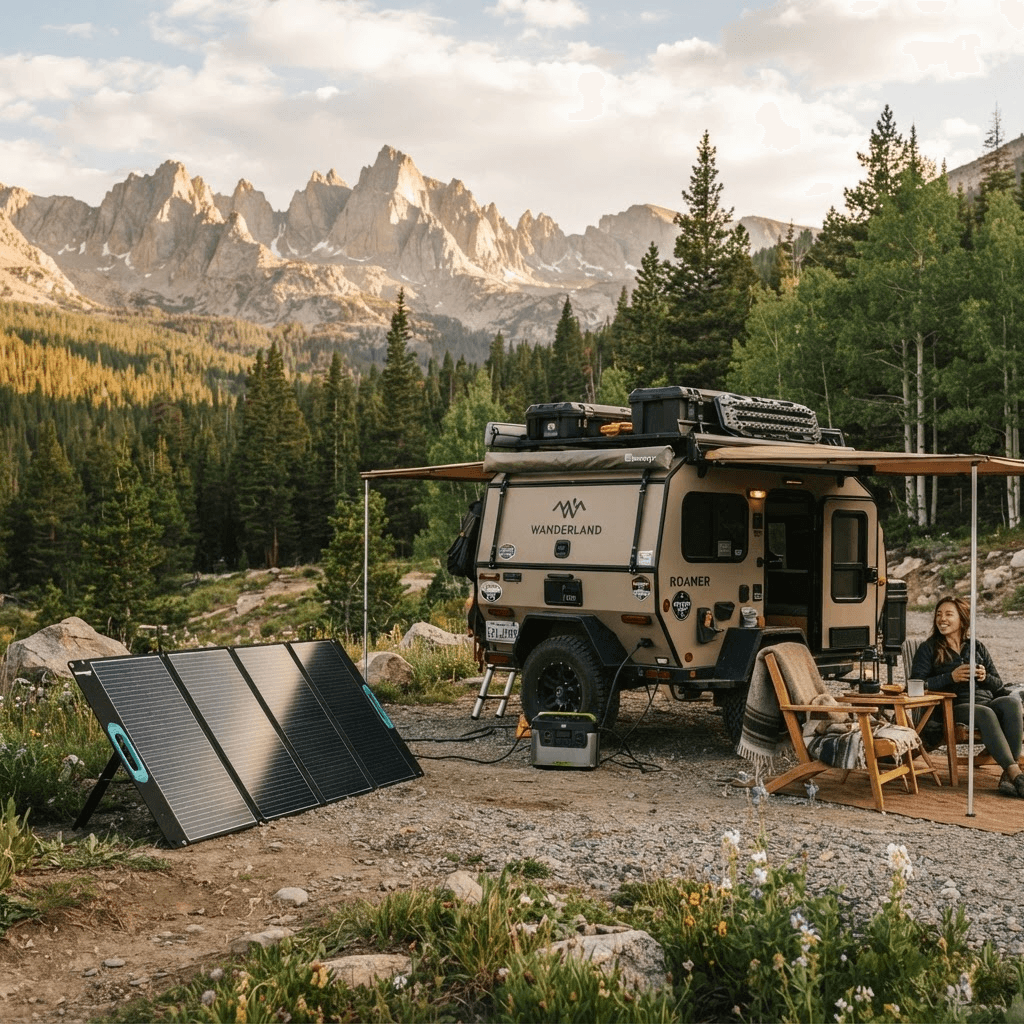
Panels for portable use come in a few flavors. Rigid panels are durable and efficient and are great mounted permanently on a trailer roof. Folding or "suitcase" panels are the most popular for camping because they pack flat, unfold with a kickstand, and can be aimed at the sun. Flexible panels are lightweight and can curve over surfaces, though they're usually a bit less efficient. Which you choose depends on whether you want a fixed installation or something you can move around.
How to Calculate Your Daily Energy Budget
Sizing the system starts with a simple exercise: add up what you actually run. List each device, roughly how many watts it draws, and how many hours a day you use it. A phone charger sips a few watt-hours; a 12-volt fridge might use 300 to 600 watt-hours a day; lights and fans are modest. Summing those daily watt-hours gives you the energy budget the rest of your system has to supply.
How to Size Your Battery for Off-Grid Camping
Your battery is sized to that budget. If you use, say, 500 watt-hours a day and want two days of buffer for cloudy weather, you need enough usable capacity to cover roughly 1,000 watt-hours. Lithium (LiFePO4) batteries have largely taken over this space because they're lighter, last far longer, and can be safely discharged much deeper than the old lead-acid batteries, which makes them well worth the higher upfront cost.
How to Size Your Solar Panel Wattage
Panel wattage is sized to refill the battery during daylight. As a rough rule, figure on getting about four to five hours of good charging sun per day, so a 200-watt panel might return somewhere around 800 to 1,000 watt-hours on a sunny day, enough to cover our example load with margin. Adding more panel capacity than the bare minimum is smart, since real-world conditions, clouds, shade, imperfect aiming, always fall short of the ideal.
PWM vs. MPPT Charge Controllers
The charge controller ties the panels to the battery, and there are two types. PWM controllers are cheaper and fine for small setups. MPPT controllers are more efficient, squeezing more usable energy out of the same panels, and they're worth it for anything beyond the smallest systems, especially in variable light. Make sure the controller is rated for your panel and battery voltages.
Portable Power Stations: The Plug-and-Play Alternative
Many campers skip building from parts and buy a portable power station instead, essentially a battery, charge controller, and inverter in one box with a solar input. These are plug-and-play: connect a folding panel, and you have power. They cost more than a DIY build for the same capacity, but the simplicity and portability are hard to beat for casual or occasional use.
Field Tips for Getting the Most Out of Portable Solar
A few field tips make a real difference. Aim panels directly at the sun and re-aim them through the day if you can, since angle dramatically affects output. Keep panels clean and unshaded, because even a little shade hurts. Watch your battery level rather than guessing. And keep power-hungry loads like electric kettles, hair dryers, and heaters off solar entirely, they'll drain a modest system in minutes and are better run on other fuel.
Getting Started with Off-Grid Solar
Start small, learn your real consumption, and scale up from there. A single folding panel, a lithium power station, and a 12-volt fridge cover a surprising amount of off-grid living. Once you've watched your battery quietly refill itself under a clear sky, you'll understand why so many campers and trailer owners never want to plug into a pedestal again.
Sizing a Portable Off-Grid System
Off-grid systems for camping and trailers are sized around what you actually run, not your whole house. Start by listing your loads, lights, a fridge, phone and laptop charging, a water pump, and estimate the watt-hours each uses per day. Add them up, pad for inefficiency, and you have your daily energy target. That number drives both the solar wattage and the battery capacity you need, keeping the setup right-sized and affordable.
The Four Core Components
Every portable off-grid setup has four essentials. The panels capture sunlight; a charge controller regulates the power flowing into the battery and prevents overcharging; the battery stores energy for use after dark; and an inverter converts stored DC into AC for standard appliances. For DC-only setups powering 12-volt gear, the inverter can sometimes be skipped, simplifying the system further.
MPPT vs. PWM Charge Controllers
The charge controller is where many portable systems win or lose efficiency. MPPT (maximum power point tracking) controllers are more efficient, squeezing more usable power out of the panels, especially in cold or low-light conditions, and are worth the extra cost for most setups. PWM (pulse width modulation) controllers are cheaper and fine for very small systems, but they leave energy on the table in larger or variable-light situations.
Folding vs. Rigid Portable Panels
Portable panels come in two main forms. Folding or blanket-style panels are lightweight, pack flat, and can be aimed at the sun and moved to follow it, ideal for tents and short stops. Rigid panels mounted on an RV or trailer roof are more durable and always working while you drive, but they cannot be reangled. Many overlanders use both: fixed panels for baseline charging and a folding panel to top up when parked in shade.
Off-grid setups borrow heavily from home system design, which we break down across our solar equipment guides.
Frequently Asked Questions
What size solar system do I need for camping or a trailer? Size it to your daily watt-hour use. Small setups running lights and charging devices may need 100 to 200 watts of panels; a trailer with a fridge and more loads often needs 300 to 600 watts plus adequate battery capacity.
Do I need a charge controller for a portable panel? Yes, for anything charging a battery. It protects the battery from overcharging. MPPT controllers are more efficient than PWM and recommended for most systems.
Are folding panels or rigid roof panels better? Folding panels are portable and can be aimed at the sun, while rigid roof panels are durable and always charging. Many campers use both for flexibility.
Can I run a fridge off a portable solar system? Yes, with adequate panel wattage and battery capacity. A 12-volt compressor fridge paired with a few hundred watts of panels and a sufficient battery is a common and reliable setup.