What are solar panels made of? (Monocrystalline explained)
A layer-by-layer breakdown of what solar panels are made of, including why monocrystalline silicon has become the default choice for home solar.
What Are Solar Panels Made Of? (Monocrystalline Explained)
A solar panel looks like a simple dark rectangle, but it's actually a precisely engineered stack of materials, each doing a specific job. Understanding what's inside not only demystifies the technology, it also explains why certain panels cost more, last longer, or squeeze more power out of the same patch of roof. Let's take one apart, layer by layer, and then zoom in on the material that matters most: the silicon cell.
Silicon: The Core of Every Solar Cell
At the heart of every panel are the solar cells, and those cells are made almost entirely of silicon. Silicon is a semiconductor, meaning it conducts electricity under the right conditions, and it's the second most abundant element in the earth's crust, refined from ordinary sand. When purified and treated, silicon is what actually converts sunlight into electricity through the photovoltaic effect.
The Layers of a Solar Panel
But the cells don't sit exposed to the weather. A finished panel is a layered sandwich built to protect that delicate silicon for decades.
- Tempered glass on top lets light through while shrugging off hail and debris
- Encapsulant sheets (usually a polymer called EVA) sit above and below the cells, sealing them against moisture
- Backsheet forms the durable bottom layer
- Aluminum frame holds the whole assembly rigid
The Metal That Moves the Power
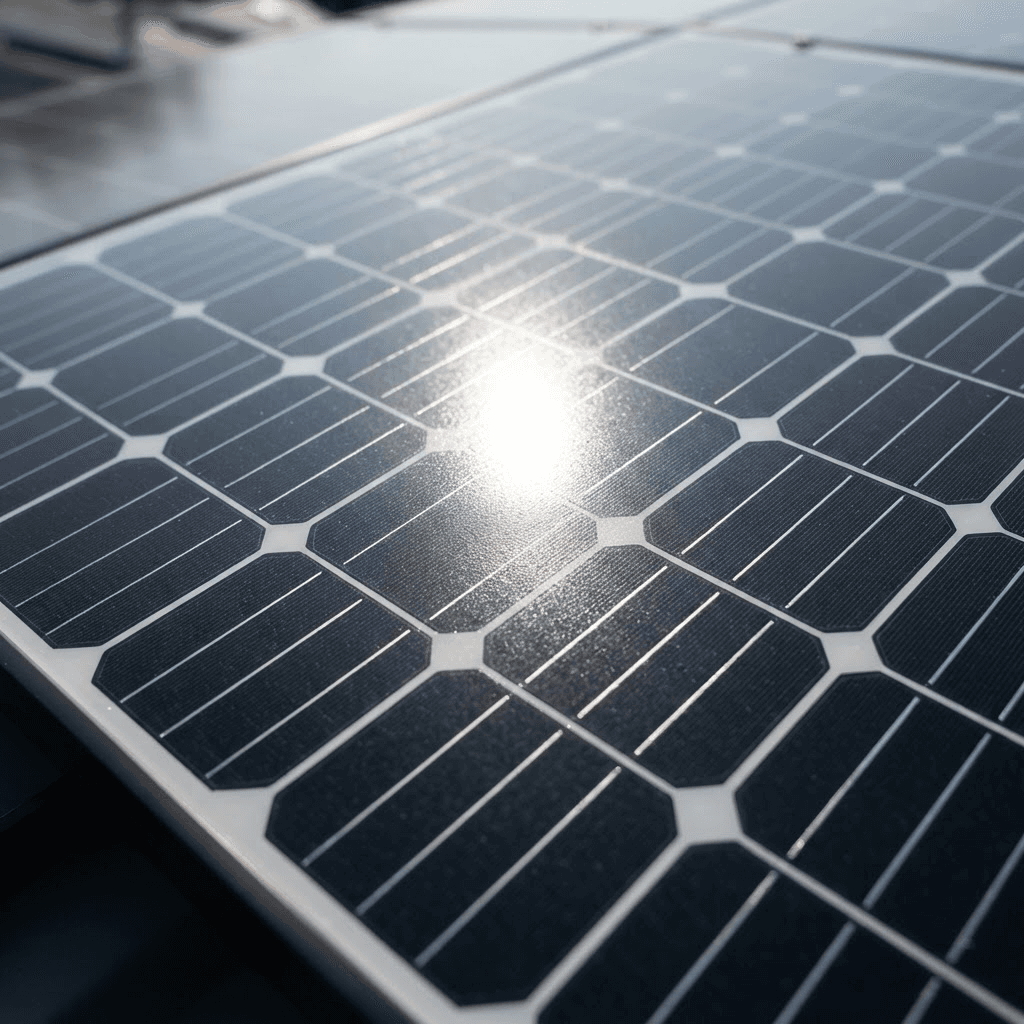
There's more metal woven through the cells themselves. Thin silver or aluminum lines printed across each cell, the fine grid you can see up close, collect the electrons the silicon releases and channel them out of the panel. Copper wiring ties the cells together into strings, and a junction box on the back gathers everything into the cables that run to your inverter.
Monocrystalline vs. Polycrystalline Silicon
Now to the important distinction: not all silicon cells are made the same way, and this is where monocrystalline enters the picture. The two dominant types are monocrystalline and polycrystalline, and the difference comes down to how the silicon crystal is formed. That single manufacturing choice ripples out into efficiency, appearance, and price.
What Makes Monocrystalline Panels More Efficient?
Monocrystalline cells are cut from a single, continuous silicon crystal. The silicon is grown into one large cylindrical ingot using a slow, precise process, then sliced into thin wafers. Because the entire cell is one uninterrupted crystal structure, electrons move through it with less resistance, which makes monocrystalline the most efficient mainstream option, typically converting 19 to 22 percent or more of sunlight into electricity.
How Polycrystalline Panels Differ
Polycrystalline cells, by contrast, are made by melting many silicon fragments together, so each cell contains numerous smaller crystals. This is cheaper to manufacture but slightly less efficient, because the boundaries between all those little crystals impede the flow of electrons. You can often tell the two apart by eye: monocrystalline cells are uniformly black with rounded corners, while polycrystalline cells have a mottled blue, marbled look.
Why Monocrystalline Dominates Residential Solar
Monocrystalline's advantages explain why it dominates residential solar today. Its higher efficiency means you need fewer panels to hit a given output, which matters enormously on a limited roof. It also tends to perform a bit better in low light and high heat, and its sleek all-black appearance is popular with homeowners who care how the array looks. The main trade-off is cost, since the single-crystal process is more involved and produces some waste.
Is Monocrystalline Worth the Extra Cost?
The good news is that the price gap has narrowed dramatically. As manufacturing has scaled up, monocrystalline panels have become only modestly more expensive than polycrystalline while delivering meaningfully more power per square foot. For most home installations, that efficiency advantage more than justifies the small premium, which is why monocrystalline has become the default recommendation.
The Bottom Line
So what are solar panels made of? At the simplest level: purified silicon cells to make the electricity, tempered glass and polymer layers to protect them, and metal contacts, wiring, and an aluminum frame to collect the power and hold it all together. And when it comes to the silicon itself, monocrystalline, grown from a single crystal for maximum efficiency, is the material quietly powering most of the rooftops going solar today.
From Sand to Silicon
The journey of a solar panel begins with one of Earth's most abundant materials: silica sand, which is quartz. It is refined at high temperatures into metallurgical-grade silicon, then purified further into the ultra-pure polysilicon that solar cells require. This purified silicon is melted and formed into crystalline structures, the starting point for the wafers that become cells. The purity of this silicon is what largely determines a cell's efficiency.
Monocrystalline vs. Polycrystalline
The key distinction in silicon panels is crystal structure. Monocrystalline cells are cut from a single continuous silicon crystal, giving them a uniform black appearance and the highest efficiency. Polycrystalline cells are made from many silicon fragments melted together, producing a bluish, speckled look and slightly lower efficiency at a lower cost. Today monocrystalline dominates the residential market because its efficiency edge means more power from the same roof.
The Other Layers of a Panel
A finished panel is far more than silicon cells. Tempered glass on top provides durability and light transmission while protecting against hail and weather. An anti-reflective coating helps the cells absorb more light. Encapsulant layers seal the cells against moisture, a backsheet or second glass layer protects the rear, and an aluminum frame provides structural strength. Thin metal conductors printed on the cells collect and carry the electricity out.
Why Materials Matter for Longevity
The quality of these materials is what lets panels survive 25-plus years on a roof. High-grade encapsulants prevent moisture intrusion that causes corrosion, and quality glass and coatings resist yellowing and micro-cracks. When comparing panels, the durability of these supporting materials matters as much as the headline efficiency of the silicon itself.
Knowing what goes into a panel makes quotes far easier to read, and our guides to choosing solar equipment pick up from there.
Frequently Asked Questions
What are solar panels made of? Primarily purified silicon cells, protected by tempered glass, encapsulant layers, a backsheet, an aluminum frame, and thin metal conductors that carry the current.
What is the difference between monocrystalline and polycrystalline panels? Monocrystalline cells come from a single silicon crystal and are more efficient with a uniform black look. Polycrystalline cells are made from multiple fragments, are slightly less efficient, and have a bluish tint.
Why is monocrystalline more efficient? Its single-crystal structure lets electrons move more freely, converting more sunlight into electricity, which means more power from the same roof area.
Are the materials in solar panels recyclable? Yes. The glass, aluminum frame, and silicon are all recoverable, and recycling programs for end-of-life panels are expanding across the industry.