Can Solar Panels Power an Entire Commercial Building?
Can solar panels power an entire commercial building? A breakdown of energy intensity, roof space, storage, and the economics that decide whether full solar coverage is realistic.
Can Solar Panels Power an Entire Commercial Building?
It's a natural question for any business owner staring at a large, flat, sun-baked roof: could solar panels power this entire building? The honest answer is that it depends, but for a meaningful number of commercial properties, running entirely on solar is genuinely achievable. For others, solar covers a large slice of the bill rather than all of it. The deciding factors are surprisingly straightforward once you lay them out.
Roof Space vs. Energy Use: The Core Factor
The first factor is the relationship between roof space and energy use, often called energy intensity. A warehouse or distribution center with a vast roof and relatively modest electrical needs is close to an ideal candidate, since it has enormous collecting area relative to its consumption. A data center or a restaurant, by contrast, packs huge energy demand into a small footprint, making 100 percent solar much harder from the roof alone.
For a rough first pass on this ratio, our panel count and roof space calculator shows how much area a given system size needs.
Which Building Types Are Best Suited for Full Solar Coverage
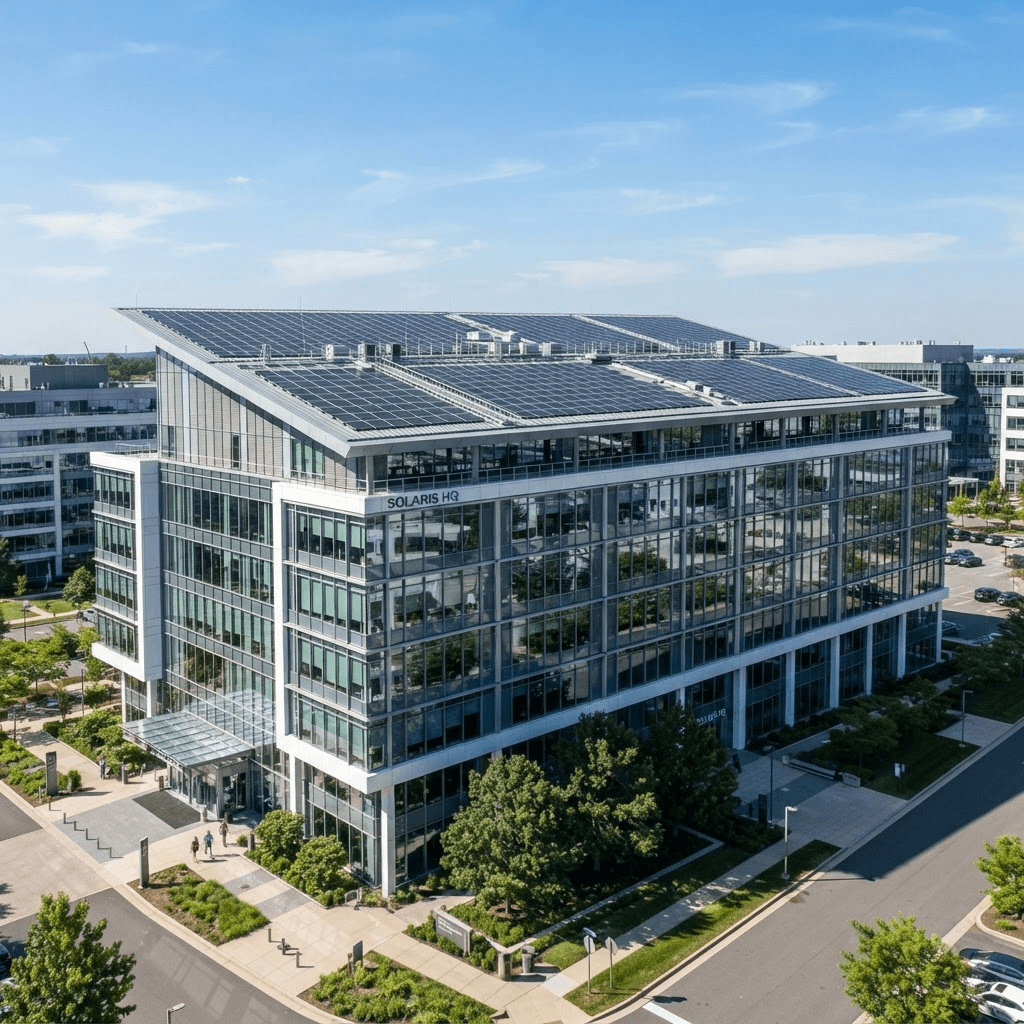
That's why the same technology produces such different outcomes across building types. Single-story buildings with big roofs, warehouses, manufacturing plants, big-box retail, agricultural facilities, frequently generate more than enough surface area to offset their full load. Multi-story offices and buildings with energy-hungry processes usually can't fit enough panels up top to cover everything, though they can still offset a substantial share.
When the Roof Isn't Enough: Other Ways to Generate Solar
When the roof isn't enough, businesses have more options than homeowners do.
- Solar carports over parking lots add large amounts of generating capacity while shading vehicles
- Ground-mounted arrays on adjacent land can dramatically expand production
- Off-site or community solar lets companies buy into panels located elsewhere, effectively powering the building remotely
Combining these can push even a demanding building toward full coverage.
How Battery Storage Extends Solar Coverage
Storage is the piece that turns daytime generation into around-the-clock power. Commercial batteries store surplus solar produced during peak sun and release it in the evening or during outages. Beyond enabling higher solar coverage, batteries help businesses avoid expensive demand charges, the fees utilities levy based on your highest spike in usage, which can be a major line item on a commercial bill.
The Economics of Commercial Solar
The economics tend to favor commercial solar strongly. Businesses can claim the federal investment tax credit, worth 30 percent of the system cost, and also depreciate the asset through accelerated schedules, which improves the return further. With commercial electricity rates and demand charges factored in, many systems pay for themselves in well under a decade and then deliver decades of low-cost power.
Why Efficiency Upgrades Matter Before You Go Solar
Efficiency work multiplies solar's impact. The less electricity a building wastes, the easier it is for a given array to cover the whole load. LED lighting, high-efficiency HVAC, smart building controls, and good insulation all lower the target that solar has to hit. In practice, the buildings that reach 100 percent solar usually got there by cutting consumption first and generating second.
Real Constraints to Plan Around
There are real constraints to plan around. Roof age and structural capacity matter, since panels last 25 years and you don't want to re-roof underneath them in five. Shading from neighboring buildings, HVAC units, and rooftop equipment reduces usable area. Local utility rules on interconnection and net metering shape how much you're credited for exported power. And a building that runs major operations at night will always lean more on storage or the grid.
So, Can Solar Power Your Entire Commercial Building?
For a low-rise building with ample roof or land and moderate energy intensity, absolutely, and many already do. For a dense, high-consumption building, solar may cover a large and worthwhile portion rather than the whole thing, especially once you add carports, storage, and efficiency upgrades. Either way, the practical path is the same: measure your consumption, maximize your available surfaces, cut waste, and let a commercial installer model exactly how close to 100 percent your particular building can get.
The Role of Battery Storage for Businesses
For a commercial building aiming to run entirely on solar, storage is often the missing piece. Panels generate during the day, but many businesses operate into the evening or overnight. Batteries let a company store midday surplus and draw it down after dark, and they also enable demand-charge management, trimming the expensive peaks that drive up commercial bills. For 24-hour operations, storage or a grid connection is usually necessary to reach full solar coverage.
Demand Charges and Why They Matter
Commercial electric bills often include demand charges based on the single highest spike of power use in a billing period, not just total energy. Solar, especially paired with a battery, can shave those peaks by supplying power during high-demand moments, producing savings that go beyond simple energy offset. This is a major reason solar economics can be even more attractive for businesses than for homes.
Financing and Incentives for Commercial Solar
Businesses have financing tools homeowners lack, including commercial loans, power purchase agreements, and accelerated depreciation on the equipment. These can dramatically improve the return on a commercial array and shorten payback. Because commercial systems are larger, they also benefit from economies of scale, often achieving a lower cost per watt than residential installations.
Sizing to Reach Full Coverage
Whether a building can hit 100 percent solar comes down to matching annual production to annual consumption. An installer models your energy use against available roof, carport, and ground space, factoring in local sun and any storage. Buildings with generous space relative to load can reach or exceed full offset; energy-dense buildings usually target the highest practical percentage rather than a strict 100 percent.
Many of the same principles apply at residential scale, which we cover throughout our solar system guides.
Frequently Asked Questions
Can solar completely power a commercial building? For many low-rise buildings with large roofs and moderate energy use, such as warehouses and big-box retail, yes. Energy-dense buildings usually offset a large share rather than the entire load.
What if the roof isn't big enough? Businesses can add solar carports over parking, ground-mounted arrays on adjacent land, or battery storage to close the gap and reach higher coverage.
Are there financial incentives for commercial solar? Yes. Businesses can often use accelerated depreciation, commercial financing, and power purchase agreements to improve returns and shorten payback.
Do commercial systems need batteries? Not always, but batteries help buildings that operate at night reach full coverage and can cut costly demand charges, improving overall savings.