How to Adopt Digital Farming Practices
Going digital can transform a farm, if you do it strategically. A practical roadmap for adopting digital farming practices step by step.
How to Adopt Digital Farming Practices: A Step-by-Step Guide
Digital farming, using data, connectivity, and digital tools to manage a farm, promises higher yields, lower costs, and more sustainable operations. But for many farmers, the leap from traditional methods to a data-driven operation feels overwhelming: Where do you start? What tools actually matter? How do you avoid wasting money on technology you won't use? The good news is that adopting digital farming doesn't require doing everything at once. With a strategic, step-by-step approach, farms of any size can go digital successfully. Here's a practical roadmap.
Step 1: Understand Digital Farming and Set Clear Goals
First, understand what digital farming actually means so you can set clear goals. Digital farming is the use of digital technologies, sensors, software, GPS, drones, data analytics, and connectivity, to monitor, manage, and optimize farming operations based on real information rather than guesswork.
Before buying anything, get clear on why you're going digital:
- Do you want to save water?
- Do you want to cut input costs?
- Do you want to boost yields?
- Do you want to improve record-keeping?
- Do you want to save labor?
- Or some combination of all of the above?
Defining specific goals and identifying your biggest pain points ensures you adopt tools that solve real problems rather than chasing shiny technology for its own sake. A farmer trying to cut water use and a farmer trying to reduce labor hours will end up buying almost entirely different tools, even though both are "going digital." Writing your goals down before you start shopping also gives you a concrete benchmark to measure results against later, rather than a vague sense that things have "gotten more modern."
Step 2: Start With Data Collection and Monitoring
Second, start with data collection and monitoring, because information is the foundation of everything digital. The simplest, highest-value entry points are usually tools that help you see your farm more clearly:
- Soil-moisture and weather sensors.
- Drone or satellite imagery for crop monitoring.
- Basic farm-management software to record and organize your activities, inputs, and results.
Even starting with a good digital record-keeping app is a meaningful first step. It replaces scattered notebooks with organized, searchable data you can actually analyze and learn from over time, and it establishes the habit of tracking that every later, more advanced tool depends on.
Step 3: Adopt Precision Tools to Act on Your Data
Third, adopt precision tools that let you act on your data. Once you're gathering information, you can begin applying it, this is where digital farming pays off:
- GPS guidance on tractors reduces overlap and waste.
- Variable-rate technology applies seed, water, and fertilizer only where needed.
- Smart irrigation systems water based on real soil and weather data rather than fixed schedules.
Introduce these gradually, adding capabilities as you grow comfortable and as the return on investment becomes clear, rather than overhauling your entire operation overnight. Each of these tools depends on the monitoring foundation from Step 2, variable-rate technology is only as good as the soil and yield data feeding it, which is exactly why data collection has to come first.
Step 4: Connect Your Tools With Integrated Software
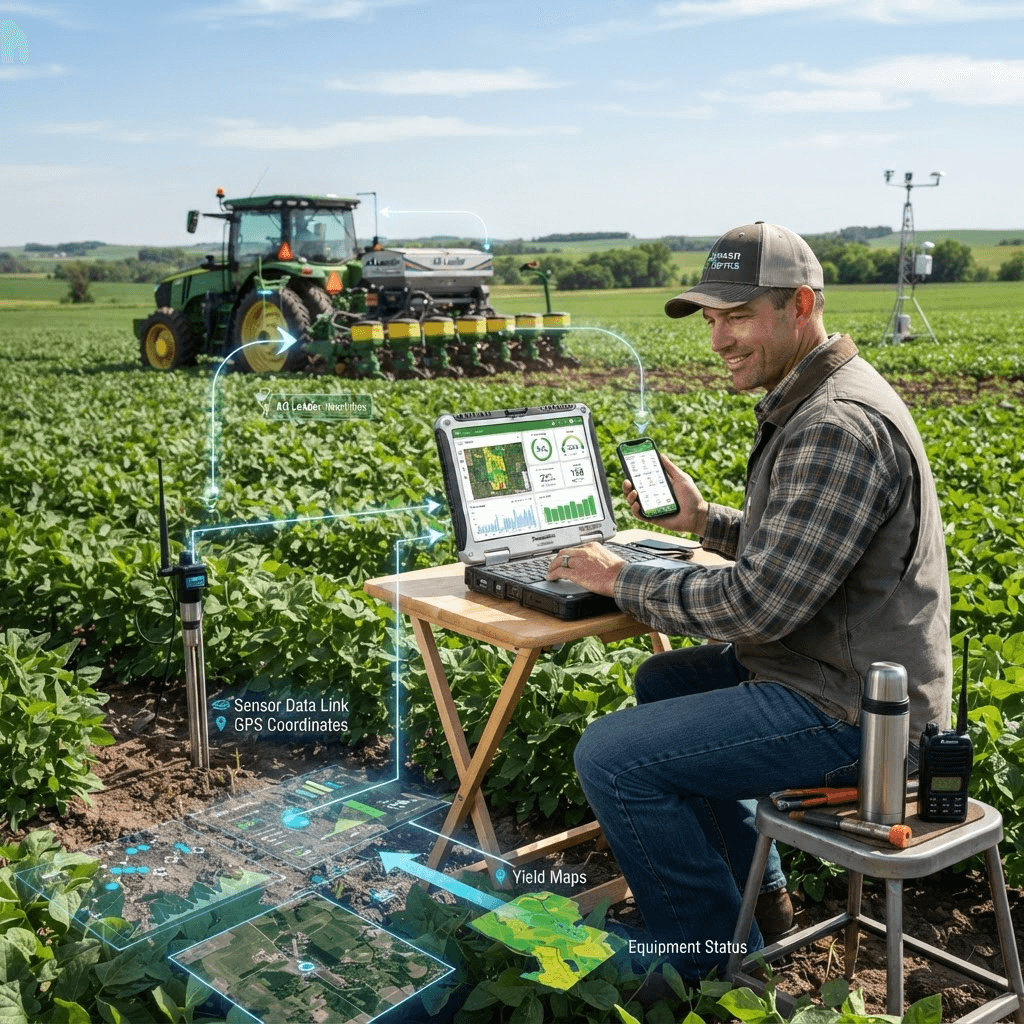
Fourth, tie it together with connectivity and integrated software. The real power of digital farming emerges when your tools talk to each other, sensors, machinery, and imagery feeding into a single farm-management platform where you can see and manage everything from one place instead of juggling separate apps and dashboards.
This does require reliable connectivity, which can be a genuine challenge in rural areas, so factor in internet or cellular coverage and look into solutions like cellular boosters, satellite internet, or on-farm mesh networks if coverage is a limiting factor for you. Choose software that integrates your key data sources and gives you clear, actionable dashboards rather than overwhelming spreadsheets full of numbers you don't have time to interpret. Before committing to a platform, ask vendors directly how well it integrates with equipment and sensors you already own, since a system that can't talk to your existing tools often ends up creating a second, disconnected data silo instead of solving the problem.
Step 5: Invest in Skills, Start Small, and Scale What Works
Finally, invest in skills, start small, and scale what works. Technology is only as good as your ability to use it, so budget real time for learning:
- Take advantage of vendor training included with most equipment and software purchases.
- Use agricultural extension programs, which often offer free or low-cost digital farming guidance.
- Explore online courses built specifically for farm technology adoption.
- Build peer networks of other digital farmers who've already worked through the same learning curve.
Begin with a small pilot: apply a new tool to one field or one problem, measure the results carefully against your goals, and expand only what proves its worth. Keep good records of costs and outcomes so you can see real ROI, rather than assuming a tool is working just because it feels sophisticated.
Common Pitfalls to Avoid When Going Digital
A few mistakes account for most failed or abandoned digital farming investments. Buying advanced tools before establishing basic data collection is one of the most common; a variable-rate applicator is only as useful as the soil and yield maps feeding it, and without that foundation it often ends up running on default settings that provide little real benefit. Underestimating the connectivity and technical support needed to keep systems running is another, since a sensor network or drone program that nobody has time to maintain quickly becomes shelf-ware. Trying to adopt too many tools simultaneously, rather than proving out one at a time, makes it hard to tell which investment is actually paying off and which is dead weight. And skipping the goal-setting step entirely, buying technology because a neighbor has it rather than because it solves a problem you actually have, is a reliable way to spend money without moving the needle on yields, costs, or labor.
How to Measure Whether Digital Farming Is Working
Tracking clear metrics from the start makes it possible to know whether a tool is actually paying for itself. Compare input costs, water, fertilizer, seed, before and after adopting a given tool on a comparable field, and track yield changes over at least one full season, ideally two, since weather variation alone can swing results significantly in any single year. Log labor hours saved or added, since some digital tools reduce time in the field while others simply shift where that time goes. Reviewing these numbers against your original goals from Step 1 tells you honestly whether to expand a tool to more of the farm, adjust how you're using it, or abandon it in favor of a different approach.
Our per-acre profit calculator gives you the baseline budget to measure those gains against, one enterprise at a time.
The Bottom Line
Adopt digital farming this way, goal-driven, incremental, data-first, and skill-supported, and you'll steadily build a modern, efficient, resilient operation without the risk and expense of trying to transform everything at once.
For a closer look at the specific tools worth adopting first, see our digital farming coverage.