Photovoltaic Cells Vs Solar Thermal: what is the difference?
Photovoltaic vs. solar thermal: what's the real difference, and which one actually fits your home? A breakdown of how each works, their efficiency, cost, and when to choose (or combine) them.
Photovoltaic Cells vs. Solar Thermal: What Is the Difference?
When people say "solar," they usually picture the dark panels that turn sunlight into electricity. But there's a second, older branch of solar technology that captures the sun's heat instead of its light. Photovoltaic and solar thermal systems both start with the same free resource, yet they do fundamentally different jobs. Knowing which is which makes it much easier to choose what actually fits your home.
How Photovoltaic (PV) Panels Work
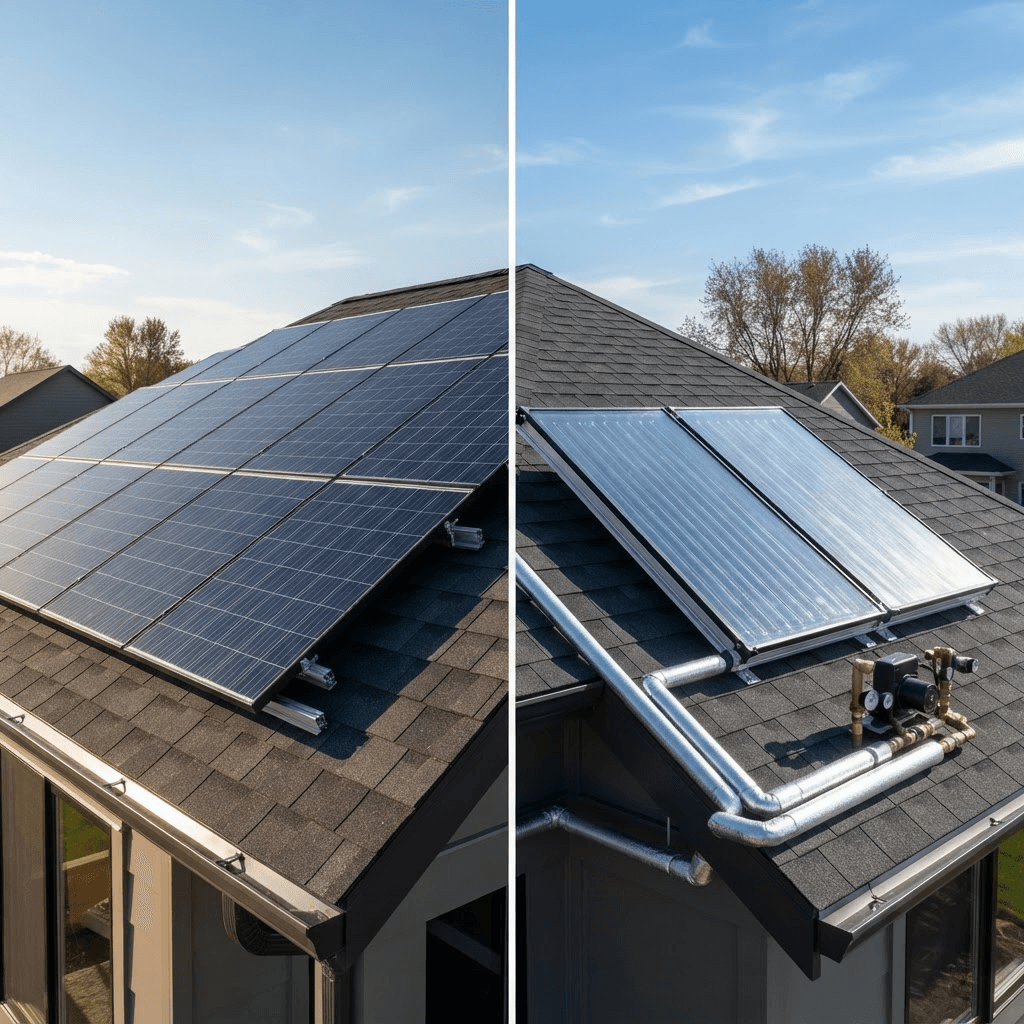
Photovoltaic panels, usually shortened to PV, convert sunlight directly into electricity. Each panel is made of semiconductor cells, typically silicon, that release electrons when sunlight strikes them. That flow of electrons is direct-current electricity, which an inverter then converts into the alternating current your home and the grid use. The output is versatile: it can power anything electrical, from lights to appliances to an EV charger.
How Solar Thermal Systems Work
Solar thermal systems do something more specific. Instead of making electricity, they use sunlight to heat a fluid, water or a heat-transfer liquid, that then warms your home's water supply or, in some designs, contributes to space heating. Dark collectors absorb solar radiation and transfer that heat into the fluid circulating through them. There's no conversion into electricity at all; the sun's energy stays in the form of heat.
The Core Difference: Electricity vs. Heat
The core difference comes down to the form of energy each produces. PV gives you electricity, which is flexible and can be stored in batteries or fed back to the grid. Solar thermal gives you heat, which is extremely efficient for its purpose but only useful where you actually need hot water or warmth. One is a general-purpose energy source; the other is a specialist.
Comparing Efficiency: PV vs. Solar Thermal
Efficiency is where the comparison gets interesting. Solar thermal collectors are remarkably good at their single task, often converting 60 to 70 percent of incoming sunlight into usable heat, far higher than PV's typical 15 to 22 percent electrical efficiency. But that number can be misleading, because heat is less versatile than electricity. A thermal system only delivers value when there's demand for hot water; a PV system can offset any electrical load in the house.
Cost and Complexity: Which System Is Simpler to Install?
Cost and complexity differ too. Solar thermal systems involve pumps, pipes, and a storage tank, and they're plumbed into your hot-water system, which can make installation and maintenance more involved. PV systems have no moving parts, degrade slowly, and have become dramatically cheaper over the past decade, which is a big reason they now dominate residential installations.
Which One Makes Sense for Your Home?
So which makes sense for a given home? PV is the better all-rounder for most households, especially where electricity rates are high or you want to power a wide range of loads and eventually add a battery or EV. Solar thermal shines in homes with heavy hot-water demand, a large family, a pool, or a climate where water heating is a major share of the energy bill.
Can You Combine PV and Solar Thermal?
It's not strictly either-or. Some homes run both, using PV for general electricity and a thermal system dedicated to hot water. There's also a hybrid category, sometimes called PVT, that combines both functions in a single collector, generating electricity while capturing the waste heat the panel produces. These are less common but can make sense where roof space is tight.
How to Decide: Look at Your Energy Bills
The simplest way to decide is to look at your bills. If your biggest energy expense is general electricity, PV almost always wins on flexibility and falling costs. If a large slice of your energy goes specifically to heating water, a solar thermal system, or a combination of the two, may pay off faster. Matching the technology to the kind of energy you actually use is the whole game.
The Bottom Line
The takeaway is that photovoltaic and solar thermal aren't competitors so much as different tools. PV makes electricity you can use anywhere; solar thermal makes heat with exceptional efficiency for a narrower purpose. Once you know which form of energy your home needs most, the right choice tends to become obvious.
Two Fundamentally Different Technologies
Although both harness the sun, photovoltaic and solar thermal systems do completely different jobs. Photovoltaic, or PV, panels convert sunlight directly into electricity using the photovoltaic effect in semiconductor cells. Solar thermal collectors instead capture the sun's heat to warm a fluid, which is then used for hot water, space heating, or in large installations to generate steam. One produces electrons; the other produces heat. Choosing between them starts with asking what you actually need: power or warmth.
How Solar Thermal Works
A solar thermal system circulates a fluid, water or a heat-transfer liquid, through collectors mounted in the sun. The heated fluid transfers its warmth to a storage tank, providing hot water or feeding a heating loop. Because converting sunlight to heat is inherently more efficient than converting it to electricity, solar thermal collectors can capture 60 to 70 percent of incoming solar energy as usable heat, far higher than a PV panel's electrical efficiency.
Efficiency Compared Fairly
At first glance, solar thermal's high efficiency looks like a clear win, but the comparison is not apples to apples. Thermal efficiency measures heat capture, while PV efficiency measures electricity generation, and electricity is a far more versatile and valuable form of energy. PV power can run anything in your home and be exported for credit, whereas thermal energy is limited to heating applications. This versatility is a major reason PV has become dominant in residential solar.
Which One Should You Choose?
For most homeowners today, PV is the default choice because it offsets your entire electric bill and pairs with net metering and batteries. Solar thermal makes the most sense in specific cases, such as high hot-water demand in sunny climates or pool heating, where its efficiency advantage is directly useful. Some homes even combine both, using PV for electricity and a small thermal system for water heating.
If PV is the direction you are leaning, our photovoltaic guides and resources go deeper on panels, inverters, and savings.
Frequently Asked Questions
What is the main difference between photovoltaic and solar thermal? Photovoltaic panels make electricity from sunlight, while solar thermal collectors capture heat to warm water or air. One produces power, the other produces heat.
Is solar thermal more efficient than photovoltaic? At capturing energy, yes, thermal collectors convert 60 to 70 percent of sunlight into heat versus roughly 20 percent for PV electricity. But electricity is far more versatile, which is why PV dominates.
Which is better for a typical home? Photovoltaic, in most cases, because it offsets your whole electric bill and works with net metering and storage. Solar thermal shines for dedicated hot-water or pool-heating needs.
Can I use both PV and solar thermal together? Yes. Many homes use PV for electricity and a compact solar thermal system for water or pool heating, capturing the strengths of each technology.