Subsistence Farming Explained
Subsistence farming feeds the farmer, not the market. A clear explanation of what it is, its main types, and its role in the world today.
Subsistence Farming Explained: Definition, Types, and Why It Still Matters
For most of human history, nearly all farming was subsistence farming, growing food to feed yourself and your family rather than to sell. While commercial agriculture now dominates the global food system, subsistence farming remains a way of life for hundreds of millions of people, especially in the developing world. Understanding what subsistence farming is, how it works, and why it persists offers important insight into food security, rural life, and the diversity of agriculture around the globe.
What Is Subsistence Farming?
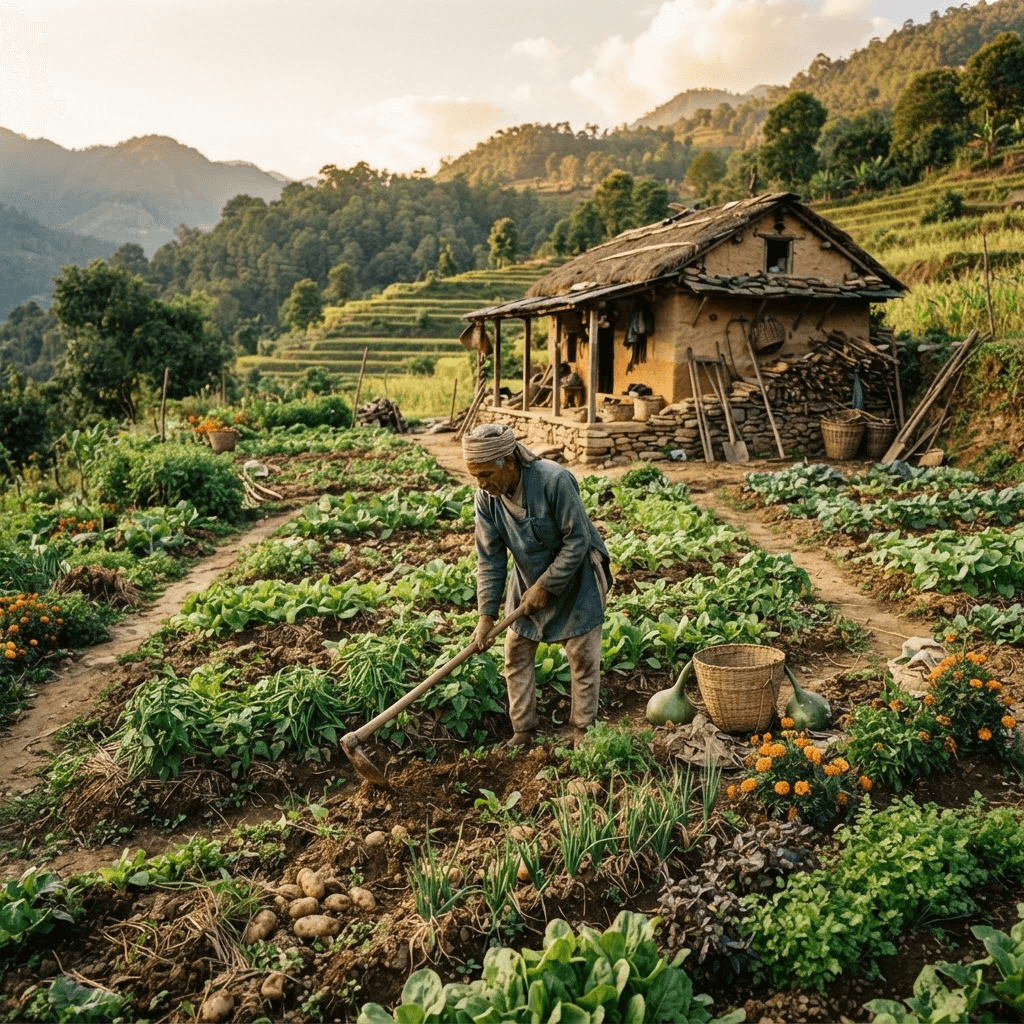
Subsistence farming is defined by its purpose: it's agriculture practiced primarily to meet the needs of the farmer and their household, with little or nothing left over to sell. The goal is self-sufficiency, producing enough food, and sometimes fiber, fuel, or other necessities, to survive, rather than generating profit.
This stands in direct contrast to commercial farming, which produces crops and livestock mainly for sale in the marketplace. In subsistence systems, the family both grows and consumes what it produces, and success is measured in having enough to eat, not in income earned. That single distinction, producing to eat versus producing to sell, is the dividing line economists and geographers use to separate subsistence agriculture from every other form of farming, including small-scale commercial operations that happen to be modest in size.
Key Characteristics of Subsistence Farming
Several characteristics typically define subsistence farming:
- Small farm size, usually just enough land to support a single household.
- Labor-intensive work, relying heavily on human and animal labor rather than machinery.
- Simple tools and low technology, with minimal external inputs like commercial fertilizers or pesticides.
- Crop and livestock diversity, growing a mix of crops and keeping a few animals to spread risk and meet varied household needs, so a bad year for one crop doesn't mean total disaster.
- Low yields per acre compared to intensive commercial farms.
- Deep ties to local conditions, with the operation shaped by local climate, traditional knowledge, and the rhythms of the seasons.
Types of Subsistence Farming
Subsistence farming takes several distinct forms, each adapted to its particular environment and social context.
Shifting Cultivation
Shifting cultivation, also called slash-and-burn farming, involves clearing and burning a patch of land, farming it for a few years until the soil's fertility declines, then moving on and letting the old plot regenerate. This method is common in tropical forest regions, where the ash from burning temporarily enriches otherwise thin soils.
Intensive Subsistence Farming
Intensive subsistence farming is widespread in densely populated parts of Asia. It works small plots very intensively, often centered on labor-heavy crops like rice, to feed large families on limited land. Because land is scarce relative to the population depending on it, every available plot is cultivated as productively as manual labor allows.
Nomadic Herding (Pastoralism)
Nomadic herding, or pastoralism, is another major form, where families move livestock across grazing lands to sustain themselves. Rather than cultivating crops, pastoralist households depend on animals like cattle, goats, sheep, or camels for milk, meat, and other necessities, moving seasonally to follow available grazing and water. This mobility is itself an adaptation, allowing communities to make productive use of arid or semi-arid land that couldn't reliably support crop farming at all.
The Strengths of Subsistence Farming
There are real strengths to subsistence farming. On the positive side, it:
- Provides direct food security for families, since the household controls its own food supply rather than depending on markets.
- Preserves traditional knowledge and crop diversity, often maintaining heirloom varieties and farming techniques refined over generations.
- Uses sustainable, low-input, locally adapted practices with a small environmental footprint, since these systems typically don't rely on synthetic fertilizers, heavy machinery, or fossil-fuel-intensive inputs.
The Challenges of Subsistence Farming
On the difficult side, subsistence farming is vulnerable. Because output is low and there's little surplus or savings, a drought, flood, pest outbreak, or family illness can quickly lead to hunger. Subsistence farmers frequently face:
- Poverty, with income, when there is any, remaining very low.
- Limited access to markets, credit, and education.
- Limited access to modern tools and inputs.
- Little cushion against bad years, which keeps many households trapped in a cycle of just barely getting by.
These vulnerabilities are compounded by climate change in many regions, since increasingly unpredictable rainfall and more frequent extreme weather events hit subsistence farmers, who have the least capacity to absorb a bad season, especially hard.
Where Subsistence Farming Persists Today
Today, subsistence farming persists largely in developing regions of Africa, Asia, and Latin America, where it remains the backbone of rural livelihoods and household food security for a huge number of people. In many of these regions, subsistence agriculture isn't a fringe practice but the dominant form of farming, employing a majority of the rural population even as national economies gradually shift toward industry and services. Understanding this scale matters: policies aimed at national food security or rural development in these countries are, in large part, policies about subsistence farming, whether or not they're labeled that way.
Efforts to Support Subsistence Farmers
Development efforts often aim to help subsistence farmers improve yields, access markets, and build resilience. Common approaches include introducing improved seed varieties suited to local conditions, expanding access to microcredit so farmers can invest in small improvements without predatory lending terms, building infrastructure like roads and storage that connect isolated farms to nearby markets, and training in techniques that boost yields without requiring expensive inputs the farmer can't sustain.
Some of these efforts aim at gradually transitioning subsistence farmers toward small-scale commercial farming, so they can move from mere survival to greater prosperity, while ideally preserving the sustainable practices and crop diversity these systems embody. The goal in most serious development work isn't to erase subsistence farming, but to reduce its fragility, giving families a buffer against bad years without stripping away the self-sufficiency and local knowledge that make these systems resilient in the first place.
The Bottom Line
Far from being a relic, subsistence farming is a living, essential part of the global agricultural picture, one that reminds us that for much of humanity, farming is still fundamentally about putting food on the family table.
To see how this fits alongside commercial and industrial models, browse our farming systems explainers.