What Is Indoor Farming and Vertical Agriculture?
Indoor and vertical farms grow food in stacked, climate-controlled spaces. A guide to how they work, their benefits, and their limitations.
What Is Indoor Farming and Vertical Agriculture?
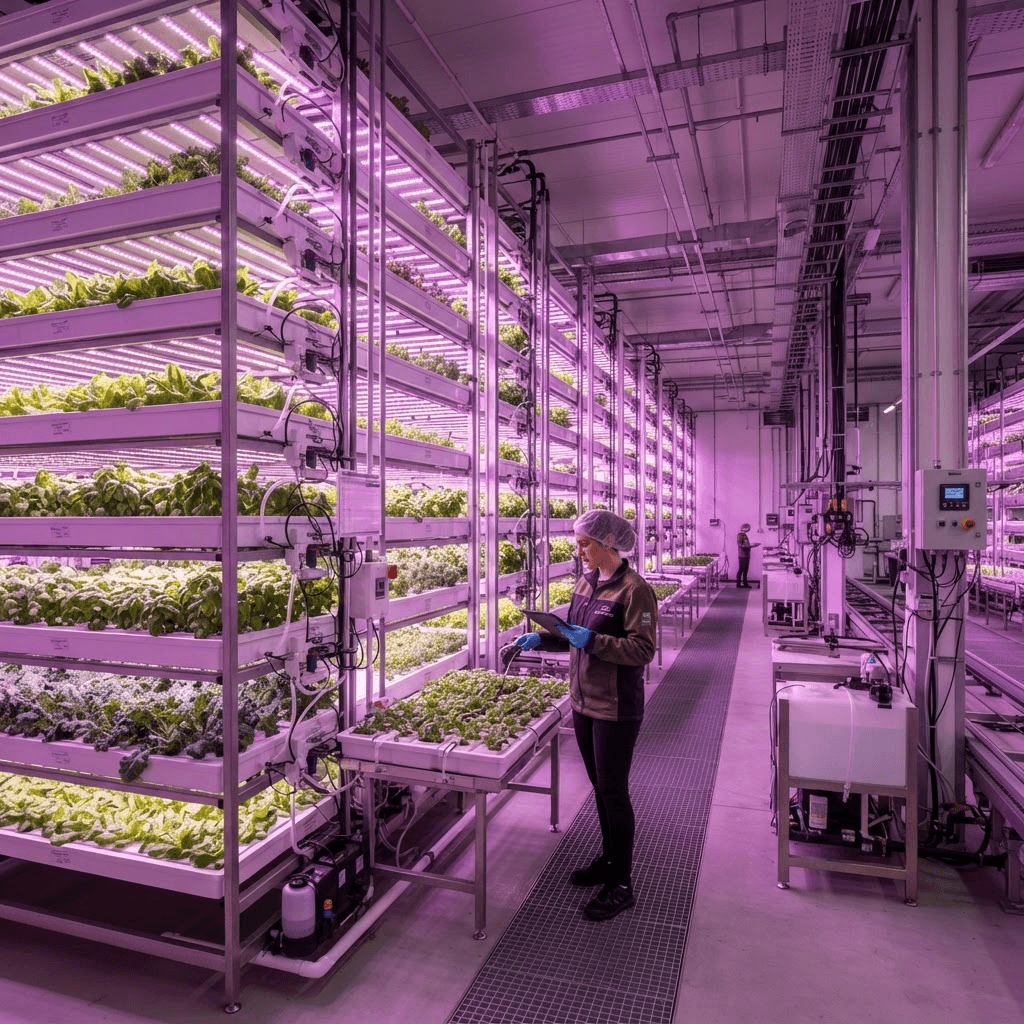
Imagine a farm inside a warehouse in the middle of a city, no soil, no sunlight, no seasons, just stacks of leafy greens growing under glowing LED lights, fed by nutrient-rich water. This is indoor farming and vertical agriculture, one of the most futuristic and fast-growing frontiers in food production. As the world's population becomes more urban and farmland grows scarcer, these controlled-environment methods offer a radically different way to grow food, and understanding how they work reveals both their exciting promise and their real limitations.
What Is Indoor Farming?
Indoor farming is exactly what it sounds like: growing crops inside enclosed, controlled environments, such as greenhouses, warehouses, shipping containers, or purpose-built facilities, rather than in open fields. Vertical agriculture, or vertical farming, takes this a step further by stacking crops in layers, growing food upward in shelves or towers to produce much more in a given floor area.
Together, these approaches share a defining idea: precisely controlling the growing environment, light, temperature, humidity, water, and nutrients, so crops can grow optimally regardless of outside weather, climate, or season.
How Indoor and Vertical Farms Actually Work
These systems typically grow plants without traditional soil, using soilless techniques:
- Hydroponics, the most common method, grows plants with their roots in nutrient-rich water solutions.
- Aeroponics mists the roots with nutrients in the air.
- Aquaponics combines fish farming with plant growing in a symbiotic loop where fish waste feeds the plants.
Because there's no natural sunlight indoors, vertical farms rely on specialized LED grow lights tuned to the exact wavelengths plants need for photosynthesis. Sophisticated sensors and automated systems constantly monitor and adjust conditions, making these some of the most high-tech, data-driven farms in existence.
The Benefits of Indoor and Vertical Farming
The benefits of indoor and vertical farming are compelling, especially for a crowded, changing world:
- Enormous yield per footprint, since growing upward in controlled spaces produces far more food in a tiny area than open fields.
- Proximity to cities, cutting the distance food travels and delivering ultra-fresh produce to urban consumers.
- Dramatically less water use than conventional farming, often recirculating it in closed loops.
- Little or no pesticides, thanks to the sealed environment.
- Year-round growing, regardless of weather, drought, or season.
- No need for fertile farmland, meaning food can be grown in deserts, cold climates, or dense cities where traditional agriculture is impossible.
The Challenges: Cost and Energy
Of course, indoor and vertical farming face significant challenges, chief among them cost and energy. Building these high-tech facilities is expensive, and running the artificial lighting and climate control consumes large amounts of electricity, which drives up operating costs and, unless powered by clean energy, environmental impact.
Because of these economics, indoor farms today work best for high-value, fast-growing crops with low light needs, leafy greens like lettuce and spinach, herbs, microgreens, and some fruits like strawberries, rather than staple calorie crops like wheat, corn, or rice, which remain far cheaper to grow in open fields. Scaling profitably is an ongoing challenge the industry is still working to solve.
The Future of Indoor Farming
Looking ahead, indoor farming and vertical agriculture aren't likely to replace traditional farming, but to complement it, filling important niches where their strengths shine. As LED efficiency improves, renewable energy gets cheaper, and automation advances, the economics keep getting better.
These farms are increasingly used to supply fresh greens to cities, grow food in harsh environments, and build resilient local food systems less vulnerable to weather and supply-chain disruptions. They represent a powerful tool in the broader effort to feed a growing, urbanizing world sustainably, proof that the future of farming may be as much about warehouses and LEDs as it is about open fields and sunshine.
For how these systems compare with field production and other emerging methods, see our controlled environment farming articles.
Frequently Asked Questions
What is indoor farming? Indoor farming is growing crops inside a controlled environment, such as a warehouse, greenhouse, or container, where light, temperature, humidity, and nutrients are managed year-round. It removes dependence on weather and season and allows production close to where food is consumed.
What is vertical agriculture? Vertical agriculture, or vertical farming, grows crops in stacked layers or vertical towers rather than a single horizontal field, multiplying the growing area within a given footprint. It is usually paired with indoor, controlled-environment methods and soil-free growing like hydroponics.
What are the benefits of indoor and vertical farming? They enable year-round harvests, far greater yield per square foot, dramatically less water use through recirculation, no weather losses, minimal pesticides, and growing near cities, which cuts transport and delivers fresher produce.
What are the drawbacks of vertical farming? The main challenges are high upfront construction costs and significant energy use for lighting and climate control. These favor high-value crops like leafy greens and herbs, though improving LED efficiency continues to widen what can be grown profitably.