How to Get Jobs in Roofing (Sales and Labor)
Roofing pays better than most entry trades and hires year-round. A guide to labor crews, the sales side, and how storm work changes the whole industry.
How to Get Jobs in Roofing (Sales and Labor)
Roofing is the trade people are most likely to dismiss and most likely to underestimate. Yes, it is hot, physical, and unforgiving of carelessness. It is also one of the highest-paying entry points in construction, one of the fastest to promote from within, and one of the very few where a motivated newcomer can be running a crew inside two seasons.
Every roof has a service life, which means the work never stops arriving. Understanding how long a roof actually lasts explains the whole business model: a finite lifespan on every structure guarantees a permanent replacement market.
The two sides of roofing
Roofing companies are split down the middle between the crews who install and the people who sell. The gap in pay structure between them is larger than in almost any other trade, and the personalities differ just as much.
The labor side
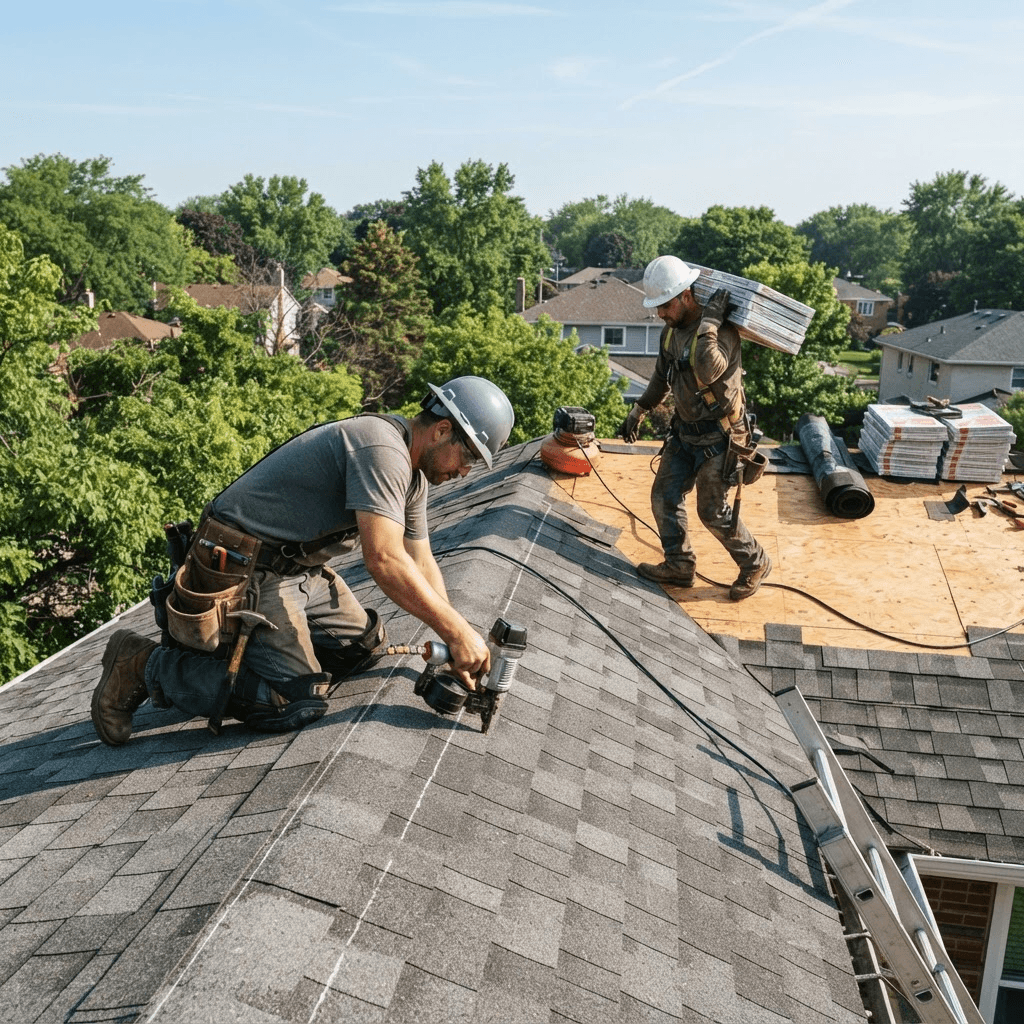
A residential tear-off and replacement is a two- to three-day project for a crew of four to six. The sequence is consistent:
- Tear-off: stripping old shingles down to the deck and getting debris into the dumpster.
- Deck inspection and repair: replacing rotten or delaminated sheathing.
- Underlayment and flashing: ice-and-water shield in valleys and at eaves, drip edge, step flashing at walls, boots at penetrations.
- Shingle installation: courses run to a chalk-line layout with correct nailing pattern and exposure.
- Ridge and ventilation: ridge vent, caps, and any static or powered ventilation.
- Cleanup: magnetic sweep for nails, which matters more to customers than anything else you do.
Tear-off is the hardest physical work in the sequence and where every helper starts. Flashing is where the actual skill lives — nearly all roof leaks are flashing failures, not shingle failures. Learning roof anatomy and the terminology of a roof diagram early will make you far more useful than a helper who only knows how to carry bundles.
Material knowledge matters too. Asphalt shingles dominate residential, but metal is growing fast, and knowing the difference between aluminum and corrugated roof panels opens up commercial and agricultural work.
The sales side
Roofing sales is its own profession. The role is part inspector, part estimator, part insurance navigator:
- Canvasser or appointment setter: knocks neighborhoods, particularly after storms, and books inspections.
- Roofing sales representative: climbs the roof, documents condition, measures, prepares the estimate, and closes.
- Insurance or claims specialist: works the adjuster process on storm-damage claims. This is the most specialized and most valuable skill in residential roofing.
- Commercial estimator: bids larger flat-roof and re-roof projects on longer cycles.
Sales is commission-driven and the earnings ceiling is high. Being able to explain what a new roof costs and why in plain language, without overselling, is what makes a rep durable rather than a one-season wonder.
Storm work: the thing nobody tells you
A significant share of the residential roofing industry runs on insurance claims after hail and wind events. When a storm hits a metro area, crews and sales teams flood in from across the country for months of concentrated work.
This is worth understanding before you take a job, because it shapes everything:
- Income becomes seasonal and geographic rather than steady.
- Travel is common, and some companies chase storms full-time.
- The claims process, not the roof itself, becomes the core competency.
- The industry attracts fly-by-night operators, so the reputation of your employer matters enormously.
Established local companies that do both storm and retail work tend to be the healthiest places to learn. Homeowners hunting for a reputable roofing contractor run into the same distinction from the other side.
What it pays
Roofing pays above most entry construction work, for the honest reason that the conditions are harder and the turnover is high:
- Laborers and tear-off helpers start above general labor rates in most markets.
- Experienced installers often move to piece rate, paid per square installed, where fast skilled crews earn considerably more than hourly equivalents.
- Foremen add a crew premium and often a share of job profit.
- Sales reps work on commission per job, with strong performers out-earning everyone on the install side.
Piece rate is the detail to understand. It rewards speed and efficiency heavily, which is great once you are skilled and rough while you are learning.
Safety, honestly
Roofing has one of the highest injury rates in construction. Falls, heat illness, and nail-gun injuries are the big three. None of this is a reason to avoid the trade, but it is a reason to be selective:
- Insist on fall protection on steep pitches, and use it.
- Take heat seriously — start early, hydrate constantly, and know the warning signs.
- Learn ladder setup properly on day one.
- Never work a wet or frosted roof.
- Walk away from any employer who treats safety equipment as optional. There are plenty who do not.
How to get hired
- Apply in late winter. Companies staff up before spring, and you get trained before the busy season rather than thrown into it.
- Lead with physical reliability. Comfort at height and willingness to do tear-off are the two things they screen for.
- Get OSHA 10 first. It is inexpensive and immediately separates you from walk-in applicants.
- Ask about piece rate versus hourly. Knowing the difference signals you understand the industry.
- Consider the sales track if you present well. Most companies will let a canvasser move into inspections quickly, and no degree is required.
Where roofing leads
The path from helper to foreman is short — often two to three seasons for someone reliable. From there, roofing is one of the most common trades to go independent in, because the equipment requirements are modest compared with the revenue per job. Many roofing company owners started on a tear-off crew, and that ladder is still genuinely open.
If you want the trade without the sales pressure, stay on the install side and specialize in flashing, metal, or low-slope commercial work. Those specialties stay in demand and get you off steep residential roofs as you get older.