How to Understand Farm Irrigation Systems
Irrigation is how farms control their most vital input: water. A guide to the main irrigation system types, how they work, and how to choose one.
How to Understand Farm Irrigation Systems
Water is the single most important input on any farm, and irrigation is how growers take control of it rather than leaving crops at the mercy of rainfall. But "irrigation" covers many different systems, from simple flooded furrows to computer-controlled drip lines, each with its own strengths, costs, and ideal uses. Understanding the main types of farm irrigation, how they work, and what drives the choice between them is essential knowledge for any farmer, gardener, or anyone curious about how our food gets the water it needs.
What Is Irrigation?
At its core, irrigation is the artificial application of water to soil to help crops grow, supplementing or replacing natural rainfall. The goal is to deliver the right amount of water, to the right place, at the right time, without wasting this increasingly precious resource.
Different systems achieve this in very different ways, and they generally fall into a few broad categories: surface irrigation, sprinkler irrigation, and drip (or micro) irrigation. Each represents a different trade-off between cost, labor, efficiency, and suitability for particular crops and terrain.
Surface Irrigation
Surface irrigation is the oldest and simplest approach, using gravity to move water across the field. Water is released to flow over the soil surface through furrows between crop rows, across flooded basins, or down graded borders, soaking into the ground as it travels.
Its big advantages are low upfront cost and no need for pumps or pressurized equipment, which is why it's still widely used worldwide, especially for row crops, rice, and pastures on relatively flat land. The downsides are efficiency and control: a lot of water can be lost to evaporation, runoff, and deep percolation, and it's hard to apply water uniformly, so it can waste water compared to modern methods.
Sprinkler Irrigation
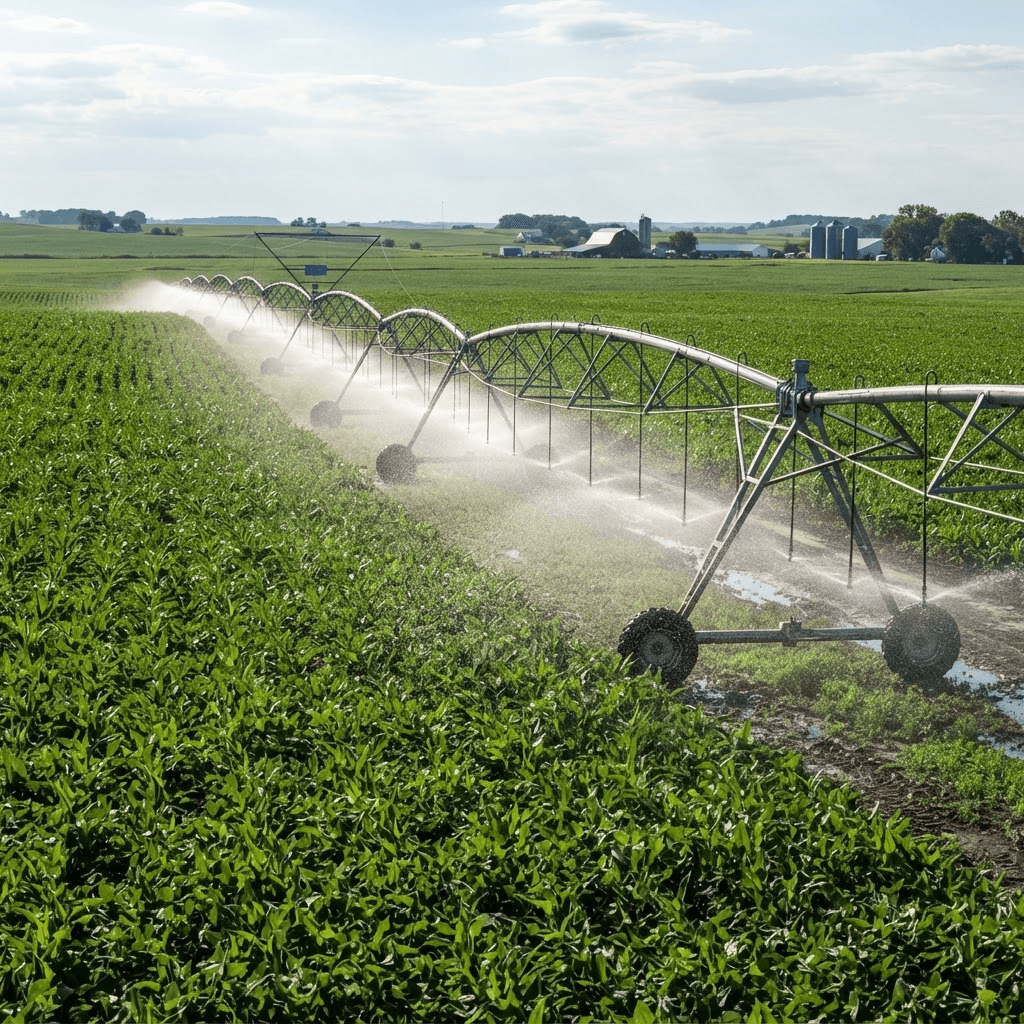
Sprinkler irrigation applies water through the air, much like rainfall, using pressurized pipes and sprinkler heads. This category includes everything from small stationary sprinklers to the giant center-pivot systems that create the iconic green circles seen from airplanes, where a long arm of sprinklers rotates around a central water source.
Sprinklers offer much better control and more uniform coverage than surface methods, work on uneven terrain, and suit a wide range of crops. The trade-offs are higher equipment and energy costs, for pumps and pressure, and some water loss to wind and evaporation, especially in hot, breezy conditions.
Drip Irrigation
Drip irrigation is the most water-efficient method, delivering water slowly and directly to the base of each plant through a network of tubes and small emitters. Because water goes right to the root zone drop by drop, evaporation and runoff are minimized and efficiency is very high, often the best of any system, while also reducing weed growth and allowing precise fertilizer delivery, known as fertigation, through the same lines.
Drip is ideal for row crops, orchards, vineyards, and vegetables, and it excels in water-scarce regions. The main drawbacks are the higher initial cost and the maintenance required to prevent emitters from clogging, which demands good filtration and clean water.
How to Choose the Right Irrigation System
Choosing the right irrigation system comes down to matching method to your specific situation:
- Crop type: orchards and vegetables often favor drip; broad row crops may suit pivots or surface irrigation.
- Land size and slope.
- Water availability and quality.
- Budget for equipment and energy.
- Local climate.
Water scarcity increasingly pushes farms toward efficient drip and well-managed sprinkler systems, and modern technology, soil-moisture sensors, timers, and weather-based controllers, can dramatically improve any system's efficiency by watering only when and where needed.
The Bottom Line
Understand these fundamentals, the types, their trade-offs, and the factors that guide selection, and you'll grasp one of the most important and impactful systems on any farm.
For how irrigation interacts with soil, crop choice, and water costs, browse our farm water management guides.
Frequently Asked Questions
What are the main types of farm irrigation systems? The three broad categories are surface irrigation (gravity moving water through furrows, basins, or borders), sprinkler irrigation (pressurized water sprayed over the crop), and drip or micro irrigation (water delivered slowly right to the root zone). Each trades off cost, labor, and efficiency.
Which irrigation system is most efficient? Drip irrigation is the most water-efficient, delivering water directly to plant roots with little lost to evaporation or runoff. Sprinkler systems fall in the middle, and traditional surface irrigation is the least efficient but the cheapest to set up.
How do I choose a farm irrigation system? Match the system to your crop, terrain, water supply, and budget. Flat row crops and abundant water may suit surface irrigation, uneven fields often favor sprinklers, and high-value crops or scarce water reward the efficiency of drip irrigation.
What is irrigation in farming? Irrigation is the artificial application of water to soil to help crops grow, supplementing or replacing rainfall. The goal is to deliver the right amount of water to the right place at the right time without wasting a limited resource.